Selling Refurbished Laptops to First-Time Buyers: Make Grade B Mean Something
New laptops cost more, so first-time buyers are trying refurbished. What to put in each listing so a Grade B laptop matches what they pictured.
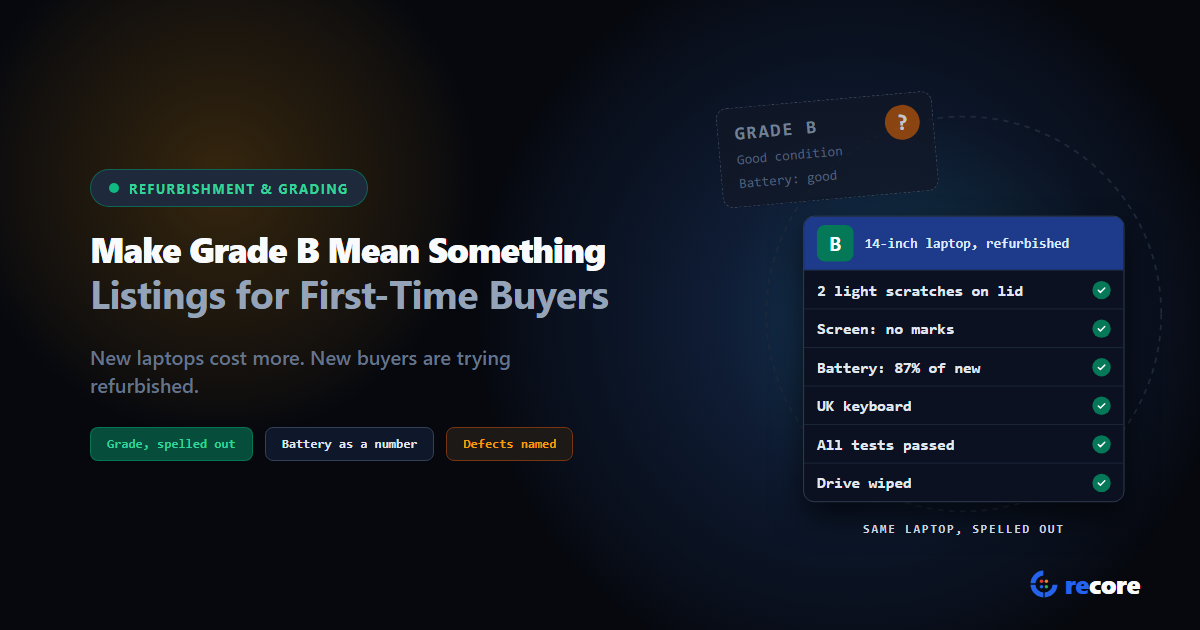
Black Friday is 27 November. This year more of the people clicking on your Grade B laptop have never bought a used one, because new laptops cost more. They see "Grade B" and picture something. You don't know what. If the box doesn't match the picture, the laptop comes back, and you pay for shipping both ways and the time to re-test it before you can sell it again.
Much of the reason is memory. Memory makers are moving output to servers, where AI demand is high, and the research firm TrendForce wrote on October 30 that PC DRAM contract prices "keep rising in the fourth quarter, though gains are narrowing." In July it said notebook prices are "rising across the board." The market research firm Context found that across Europe's five largest markets, "refurbished PC unit sales through distribution rose 7% year-on-year in Q4 2025." So refurbished laptops are reaching more buyers, and some of them will be buying used for the first time.
- New laptops are getting more expensive, and refurbished ones are reaching buyers who've never bought one before.
- A first-time buyer has never seen your grade guide. "Grade B" alone leaves them to imagine the rest.
- Spell it out in every listing: what the grade means on this unit, whether it all works, the battery as a number, the keyboard layout, what you tested, and the wipe.
- Test before you list, grade the same way across techs, and write a returns policy that separates "not as described" from "changed my mind".
1. Who is buying, and why it changes your listings
Context's numbers are from distribution in Europe, so read them as a direction rather than a forecast for your shop. The figures cover the last three months of 2025, when memory prices were starting to climb, so read them as the start of a trend rather than a measure of this season. Context says its analysis "confirms that affordability is the primary driver of growth in the refurbished segment." The price bands back that up: "For notebooks, the €200–€300 price band continues to dominate, accounting for around 40% of sales."
Someone spending €250 may never have bought a used laptop before. They may not know that refurbishers grade differently from each other. They don't know what a battery's health percentage means, or that a UK keyboard has a taller Enter key than a US one. (If you want the wider market picture, we covered memory prices and what they mean for ITAD intake in September.)
A trade buyer reads your grade guide and prices the risk. A first-time buyer reads the photos and the first line of text, then fills in the gaps with hope.
2. Why "Grade B" goes wrong
There's no common grading scale for laptops. Each seller writes its own, and inside one shop two people can grade the same scratch two ways. We set out the evidence in Your Grade A Could Be Someone Else's Grade B.
With trade buyers, that gap turns into a credit note. With consumers, it turns into a return, and the rules let them make it. The EU's Your Europe site says that if you buy a product online, "you can cancel the contract within 14 days without providing any justification", counted "from the date of delivery." One exception is goods bought from a private individual, and a shop selling refurbished laptops online isn't one. Outside the EU, check the rules where you sell.
Your returns policy can't stop those returns. Your listing can make them rarer. A buyer who saw the two lid scratches before paying got what they expected, and that buyer is the one who keeps the laptop.
3. What to put in every listing
Each line answers a question a first-time buyer would ask you if they could. We'd put all nine in every listing.
| Field | Write this | Instead of this |
|---|---|---|
| Cosmetic grade, with its meaning | "Grade B: two light scratches on the lid, visible at an angle. Screen has no marks." | "Grade B, good condition" |
| Working condition, on its own line | "Everything works. All tests passed." Or: "Works, except the webcam." | Nothing, or a working fault hidden inside the grade |
| Battery health, as a number | "Battery health 87%: it holds 87% of the charge it held when new." | "Battery good" |
| Keyboard layout | "UK layout (tall Enter key, £ on the 3 key)" | Nothing, or a photo taken from too far away to tell |
| Specs read from the machine | Exact CPU, RAM, storage size and type, screen size and resolution | Specs copied from the model's brochure |
| What you tested | "Tested: battery, screen, keyboard, trackpad, camera, speakers, ports, Wi-Fi, storage health" | "Fully tested" |
| Data wipe | "Drive wiped before sale. Wipe certificate available." | Nothing |
| Named defects, with photos | "Small dent, bottom left corner (photo 4)" | "Minor signs of use" |
| What's in the box | "Charger included (65 W, compatible, not original)" | "Comes with charger" |
Two things to get right:
Keep the grade and the working condition apart. The grade is how it looks. The condition is how it works. A spotless laptop with a dead webcam is Grade A, working with one named fault, and both facts go on the listing. A buyer who reads about the webcam before paying has made an informed choice.
Explain the battery number once, in plain words. Battery health is how much charge the battery holds today compared with when it was new. Put the measured figure on the listing. Pick a minimum, for example 80%. Replace any battery below it, or put the figure in the listing's first line. Our battery health guide covers how to read it in bulk and when the number misleads.
4. Test before you list
Every claim in your listing should come from a test you ran. Before a laptop goes on sale, check at least:
- Battery health and charging. Read the health figure, and confirm it actually charges on the charger you're shipping with it.
- Screen. Full-screen solid colours to find dead pixels, bright patches and backlight bleed.
- Keyboard. Every key, not a sample. A dead key is the kind of fault a buyer finds in the first five minutes.
- Trackpad, camera, speakers and microphone.
- Every port, with a real cable or device in each.
- Wi-Fi and Bluetooth.
- Storage health, then the wipe.
- A short stress run, so a machine that overheats or shuts down under load doesn't leave as "working".
If a laptop fails one of these, the listing says so, or it doesn't go out as working. That one rule removes most of the reasons for a "not as described" return.
5. Keep grades the same when the floor gets busy
Holiday volume often means extra hands at the bench. Your grade only means something if every tech applies it the same way. Three rules do most of the work:
- One written defect list, with a severity for each defect, so "deep scratch" means one you can feel with a fingernail.
- The worst cosmetic defect sets the grade. Nobody averages a dented lid against a perfect screen.
- Calibrate new people first. Have them grade the same 20 laptops as an experienced tech, and fix every definition they disagree on.
Our laptop grading criteria template has a full defect list and the calibration steps, free to copy.
6. Returns policy wording that helps both sides
A clear policy makes returns easier to judge. You'll get two kinds, and they need different answers. Something like:
If it isn't as described. If your laptop has a fault or a cosmetic mark that isn't in the listing or the photos, tell us within 14 days of delivery. We'll pay return shipping and refund you in full or send a replacement, your choice.
If you change your mind. You can return it within 14 days of delivery for a refund. Please send it back with everything it came with.
What the grade means. Grade B laptops have light cosmetic wear and work fully. Every mark we found is listed and photographed.
Adjust the periods and who pays shipping to your local law and your margins. Keep the promise in the first paragraph, because it's what makes an honest listing pay off: a buyer who trusts the description is less nervous about clicking buy.
7. Where reCore fits
reCore boots each laptop into its station app. There, the wipe, 17 automated tests, a stress test and grading run as one flow. The station's battery test is part of that flow. Your techs do 6 guided manual checks: camera in 3 to 6 seconds, display in 6 to 14, ports in about 12, keyboard in about 25, all under a minute per laptop, measured per device on real stations.
Grading follows a profile your organisation sets in the dashboard, so every station asks the same questions. The stock list is built from the device data, with battery ranges and named defects, and no re-typing. reCore doesn't write marketplace listings. What it gives you is a record of each laptop with the tested specs, battery health, test results, grade, defects and wipe already filled in.
If you'd like to see that record for one of your own laptops, email [email protected].
Before Black Friday
Higher memory prices mean some of this season's buyers will be buying a used laptop for the first time, and few of them will have read a grade guide. Pull your top 20 listings this week and check each against the table in section 3. Rewrite any that say only "Grade B".
Sources
- TrendForce, DRAM Contract Price Oct. 2026, October 30, 2026. Quote from the public summary.
- TrendForce, Global Notebook Shipments Forecast to Decline 13.6% in 2026, July 1, 2026. Source for AI server demand taking memory capacity.
- Context, UK Leads Europe's Refurbished PC Surge as Retailers Face Quality and Supply Pressures, February 12, 2026. Source of the 7% and 40% figures and the affordability quote.
- European Union, Your Europe: Returns and the right of withdrawal, on the 14-day right to cancel online purchases.
Frequently asked questions
What does Grade B mean on a refurbished laptop?
There's no shared scale for laptops, so Grade B means whatever the seller says it means. Usually it's light cosmetic wear on a machine that works fully. A good listing says exactly which marks, where, and how many, so the buyer doesn't have to guess.
How should I show battery health in a refurbished laptop listing?
As a measured number, such as 'battery health 87%', with one line explaining that this is how much charge the battery holds compared with when it was new. Words like 'good' or 'excellent' mean different things to different buyers.
Do EU buyers have to be allowed to return a refurbished laptop?
If you sell online as a business, generally yes. The EU's Your Europe site says that if you buy a product online you can cancel the contract within 14 days without giving any reason, counted from the date of delivery. Goods bought from a private individual are not covered. Outside the EU, check the rules where you sell.
How do I keep grades consistent when I hire extra staff for the holidays?
Give every tech the same written defect list, with a severity for each defect, and let the worst part set the grade. Before a new person grades on their own, have them grade the same 20 laptops as an experienced tech and fix every definition they disagree on.
reCore Research Lab
OfficialCompliance & Security Group
Technical research group specializing in NIST SP 800-88, IEEE 2883, SERI R2v3 standards, and forensic data recovery testing.
Make your grade mean one thing
Write your grading standard once. Every station asks its questions and suggests the same grade for the same answers.
Related Guides & Research
Continue exploring compliance standards, firmware sanitization, and hardware diagnostics.
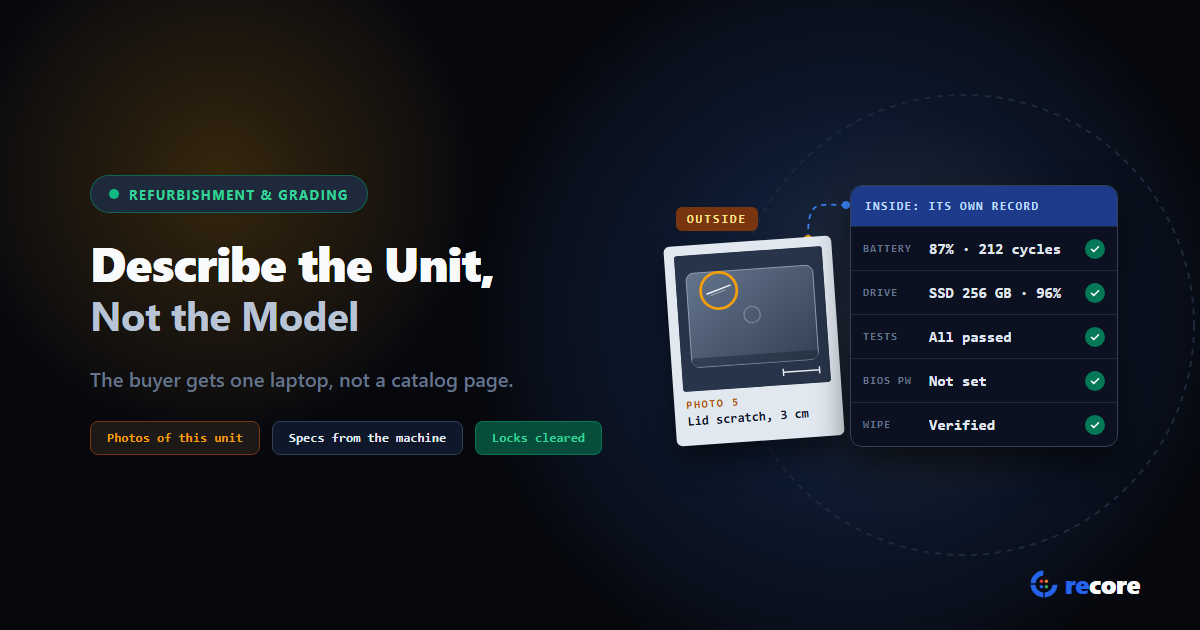
Describe the Unit, Not the Model: Refurbished Laptop Listings for Black Friday
Buyers get one laptop, not a catalog page. What to photograph, what to read from the machine, and a unit description template to copy before Black Friday.
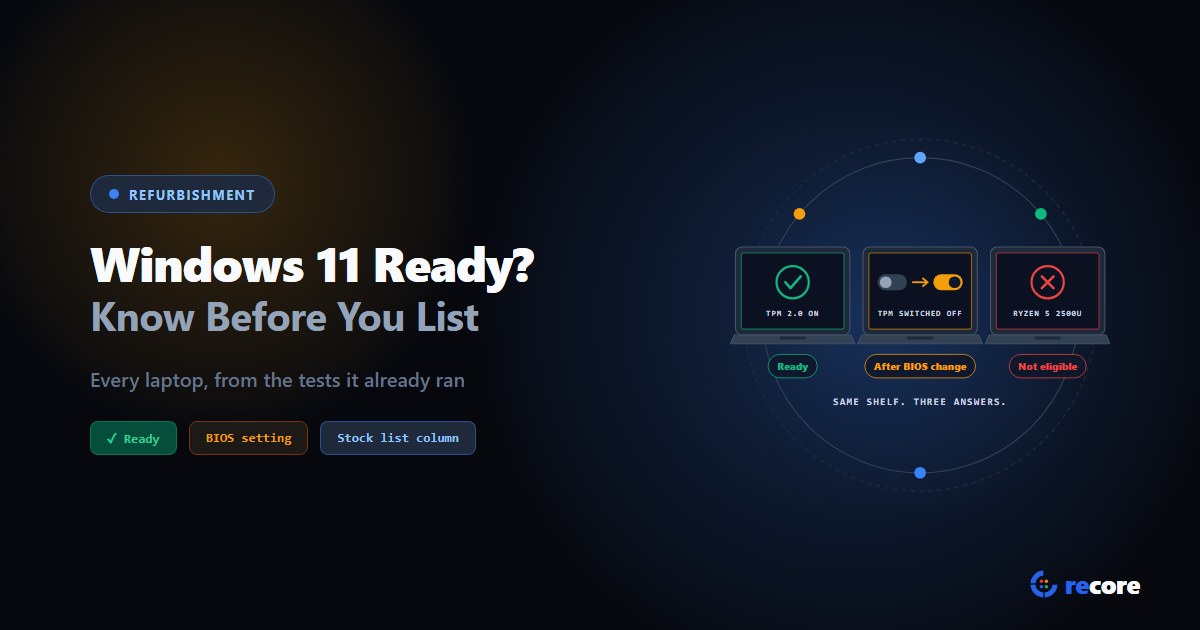
Windows 11 Ready? Check Every Refurbished Laptop Before You List It
How to tell which used laptops can run Windows 11, which need only a BIOS setting, and which can't, without installing Windows. Plus a free sample stock list.
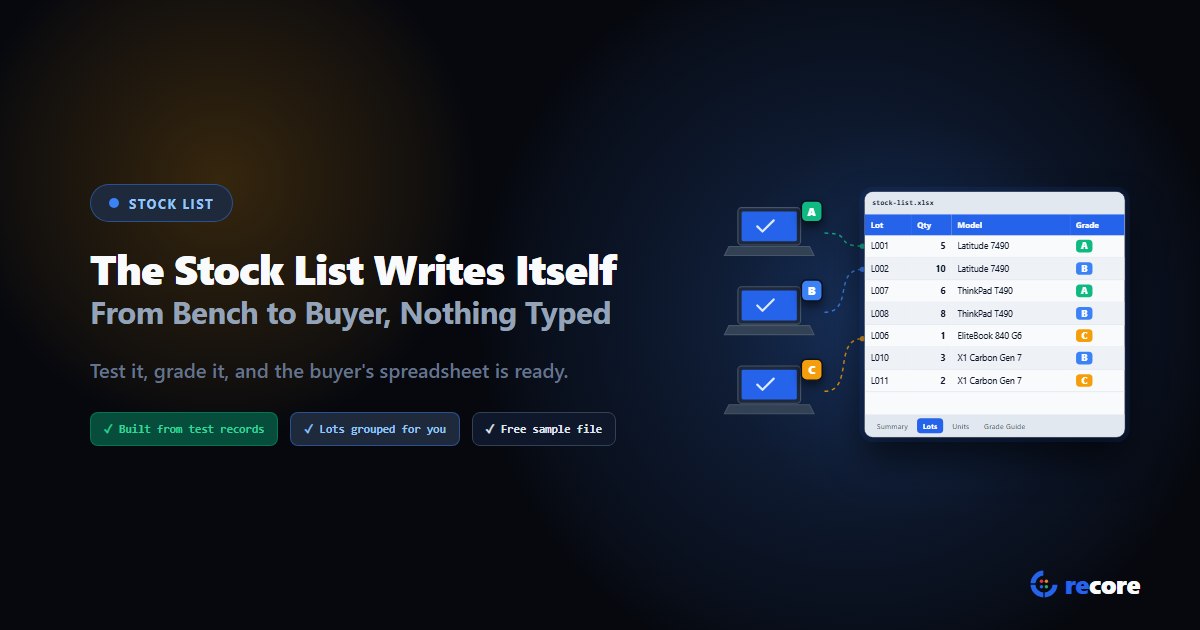
The Stock List Writes Itself: From Bench to Buyer Without a Spreadsheet
What a buyer needs on a refurbished laptop stock list, why hand-typed lists cost you credits, and how reCore builds one from test records. Free sample file.
Stay Ahead in Data Sanitization & ITAD Compliance
Join enterprise IT managers and electronics refurbishers receiving our monthly technical standards breakdowns, NIST/R2v3 audit tips, and benchmark releases.