PC Revenue Up 18%, Units Down 16%: What the Memory Squeeze Means for ITAD
HP sold 16% fewer PCs last quarter while revenue rose 18%, and memory prices hit records. What fewer, pricier, older devices mean for ITAD intake, RAM and SSD reuse.
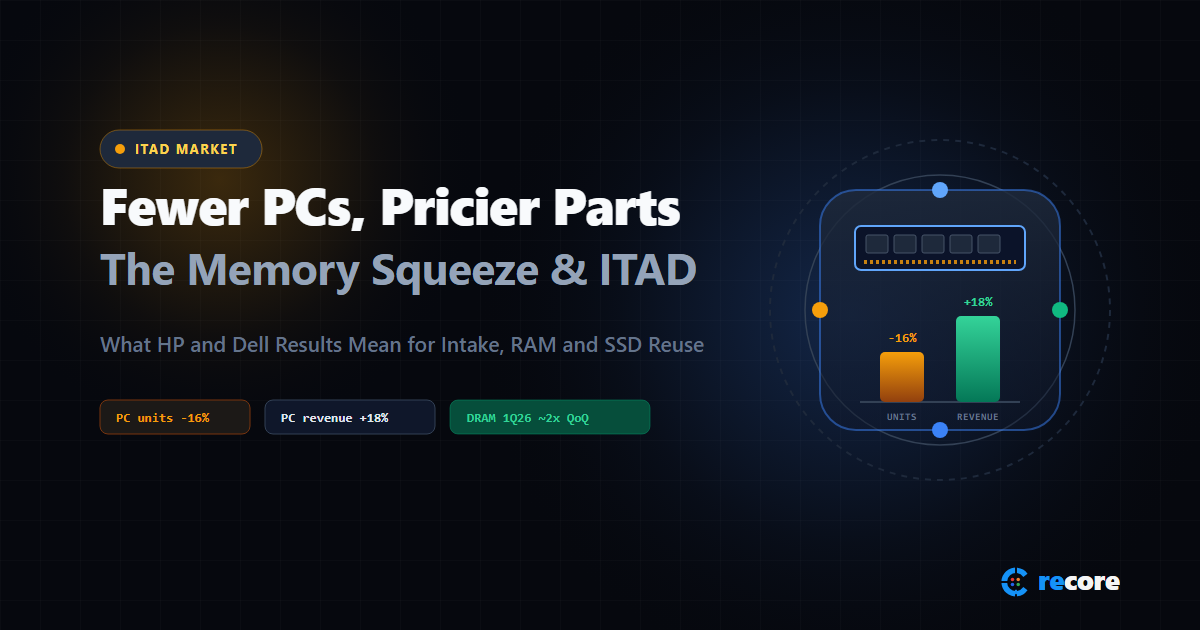
Here is the number that should be on every ITAD operator's desk this quarter. In the three months to July 31, 2026, HP sold 16% fewer PCs and took in 18% more PC revenue.
That is not a paradox. It is what happens when memory and storage, two of the most expensive parts of a PC, get sharply more expensive, and manufacturers respond by selling fewer, pricier machines. For ITAD, it changes three things at once: how many devices will arrive, how old they will be, and how much the parts inside them may be worth.
OEM figures come from HP's and Dell's own earnings releases and calls. Memory prices come from TrendForce's published surveys and forecasts. Everything about what this means for ITAD intake and component value is our analysis, labelled as such. We did not find authoritative public data on used-component prices or future ITAD volumes, and we don't estimate either.
1. What the PC makers actually reported
HP, fiscal Q3 2026 (quarter ended July 31, 2026, earnings release and August 26 call):
| Measure | Change year over year |
|---|---|
| Personal Systems revenue | +18%, to $11.8 billion |
| Commercial PC revenue | +22% |
| Total PC units | -16% |
| Commercial PC units | -14% |
| Consumer PC units | -19% |
On the call, CFO Karen Parkhill said the revenue growth came from "prioritization of higher-value unit placements, repricing for higher commodity costs and services expansion." Looking ahead, she said HP remains aligned with industry experts projecting the PC market "to decline high teens year-over-year for the second half of the calendar year," and that HP expects "memory and storage costs to increase further as a percentage of the bill of materials." Asked about the Windows 11 upgrade cycle, she said: "We now see roughly 70% of the Win 11 refresh complete."
Dell, fiscal Q2 2027 (reported September 1, 2026):
- Client Solutions Group revenue rose 20% to $15.0 billion. Commercial client revenue rose 22% to $13.2 billion.
- On the call, Dell said large enterprises "continue to refresh their PC installed base," while "more cost-sensitive customers are extending their upgrade cycles. This is increasing the number of older devices in the installed base."
- Traditional server revenue rose 122%, and Dell said "the majority of the installed base" is still on 14th-generation or older servers.
Two companies, one message: PC spending is holding up because prices are rising, not because more machines are shipping.
2. Why: memory prices at record highs
The driver is memory. TrendForce reported that conventional DRAM contract prices rose roughly 93% to 98% quarter over quarter in the first quarter of 2026, and forecast another 58% to 63% in the second quarter. Suppliers are prioritizing high-margin AI server memory, which leaves less for PCs and phones. The same report notes "sharp increases in DDR4 and DDR3 contract prices," which matters here because DDR4 is what most retiring business PCs contain.
For the third quarter, TrendForce's July forecast is slower but still upward: conventional DRAM +13% to 18% and NAND Flash +10% to 15%, with contract prices "already at record highs" and consumer buyers "reaching their affordability limit." It expects retail notebook prices to "rise across the board" as higher-cost components flow through, "weighing on full-year shipment volumes."
Two cautions. These are contract prices for new chips, not prices for used modules. And the second- and third-quarter figures are forecasts.
3. What this means for ITAD intake (analysis)
Fewer PCs will arrive, later. Devices that aren't shipped in 2026 won't be retired in 2029 or 2030. With HP pointing to a high-teens drop in second-half shipments, the pipeline that feeds laptop and desktop intake is thinning at the source. We can't say by how much or exactly when; that depends on refresh cycles no one publishes.
The Windows 11 wave is mostly behind us. Much of the corporate displacement volume since 2024 was tied to the Windows 10 end-of-support deadline (see our Windows 10 ESU triage framework). If roughly 70% of that refresh is done, the remaining 30% is the tail, not a new wave.
What does arrive will be older. Dell's comment is the important one: cost-sensitive customers are stretching cycles, and that increases the number of older devices in use. Older devices mean more battery wear, more failed components, and more units whose best route is parts recovery rather than resale.
Servers go the other way. Dell's 122% traditional server growth, with most of its installed base on older generations, points to a data-center refresh that produces server, storage and memory intake. For facilities set up for data-center work, that is where volume is moving (we covered GPU clusters in our AI server decommissioning guide).
4. The parts inside are the story
When the contract price of new DRAM roughly doubles in a single quarter, the RAM and SSD inside a retired laptop stop being an afterthought.
- RAM. A business laptop or desktop retired today typically carries DDR4. When new DDR4 contract prices rise sharply, buyers of refurbished machines and upgrade parts have more reason to look at tested used modules. That is a direction, not a price: we found no authoritative public index of used-module prices, so value your parts from your own sales history.
- SSDs. A drive that is shredded has only scrap value. A drive that is sanitized, verified and in good health can be reused, either in the refurbished device or on its own. Higher NAND prices raise what destruction costs you in lost value.
The catch is that reuse is only an option when you can prove two things per component: that it works, and, for storage, that it was properly sanitized. That brings the economics straight back to evidence. Our NIST SP 800-88 Rev. 2 guide covers what a defensible per-drive record contains; DBAN for SSDs covers why the method has to match the media.
Many customers require physical destruction of storage by contract or policy. Higher component value is a reason to review that choice with them, not a reason to override it.
5. What to change on the floor
A practical checklist for fewer, older, more valuable devices:
- Record memory configuration per device at intake. Module count, capacity, generation (DDR4, DDR5), speed and manufacturer. Without it you can't decide which units are worth harvesting.
- Test memory before you harvest it. A module pulled without a test is a guess. Record the result against the module and the donor device.
- Grade storage by health, not just capacity. Check SMART data such as reallocated sectors and power-on hours before deciding between reuse and destruction.
- Keep one sanitization record per drive. Method, verification, approval and final route, so a reused SSD comes with its own evidence.
- Route per component, not per device. A grade-D laptop can hold grade-A RAM and a healthy SSD. Your system should be able to record that.
- Revisit destruction-by-default with customers. Where contracts allow sanitize-and-reuse, show them the evidence you produce.
- Watch your server intake. If your facility handles data-center equipment, plan capacity for the server refresh Dell is describing.
6. Where reCore fits
reCore records the information this shift makes more valuable. Its diagnostics capture each device's memory configuration in the form "32GB+32GB (64GB) DDR4 2933MHz, SK Hynix," and run a memory stress test that checks for bit flips and controller faults. Before a wipe, it checks drive health from SMART data, including reallocated sectors and power-on hours, and blocks the wipe on a critically failing drive. Each drive gets its own sanitization record with verification and a separate approval, and devices are graded component by component.
reCore does not price components, predict market movements, or decide whether a customer's contract permits reuse. It gives you the per-device and per-drive evidence those decisions depend on.
7. What the evidence does not show
- How much ITAD volume will fall, or when. No authoritative source publishes retirement forecasts at that level.
- Used-component prices. Contract prices for new DRAM and NAND are published; prices for used DDR4 modules and used SSDs are not, in any source we'd treat as authoritative.
- Whether memory prices will stay high. TrendForce's own forecast shows increases slowing in the third quarter.
- That every OEM is in the same position. HP and Dell reported similar patterns; other manufacturers may differ.
Conclusion
For two years, ITAD growth leaned on volume: the Windows 11 deadline pushed large, predictable batches of business PCs out of service. The latest OEM numbers point to a different mix: fewer PCs, retired later, with more valuable parts inside, and a server refresh running in the other direction. Facilities that can test, record and route individual components will capture that value. Facilities that process by the pallet will see less volume and leave the parts value on the table.
Sources
- HP Inc., Fiscal 2026 Third Quarter Results, August 26, 2026; HP Q3 FY2026 earnings call, August 26, 2026 (transcript).
- Dell Technologies, Second Quarter Fiscal 2027 Financial Results, September 1, 2026; Dell Q2 FY2027 earnings call (transcript).
- TrendForce, Rapid Contract Price Surge Drives 1Q26 DRAM Industry Up 81% QoQ, June 1, 2026.
- TrendForce, AI Server Demand Continues to Support Memory Prices in 3Q26, July 3, 2026.
reCore Research Lab
OfficialCompliance & Security Group
Technical research group specializing in NIST SP 800-88, IEEE 2883, SERI R2v3 standards, and forensic data recovery testing.
Automate Testing & Evidence for R2v3 Operations
Deploy reCore across hundreds of devices simultaneously with zero-touch PXE or USB boot. Generate SHA-256 verified PDF erasure certificates with separation of duties enforcement.
Related Guides & Research
Continue exploring compliance standards, firmware sanitization, and hardware diagnostics.
SSD Reuse vs Shredding: What Makes Reuse Defensible, and What Your Contract Should Say
NIST SP 800-88 Rev. 2 advises against shredding modern storage for anything but low-sensitivity data. What SSD reuse needs to be defensible, and the contract terms to agree.
One Year After NIST SP 800-88 Rev. 2: A Wipe Result Is Not a Sanitization Record
NIST SP 800-88 Rev. 2 moves the focus from wipe techniques to sanitization programs, verification, validation and records. What an ITAD record should prove.
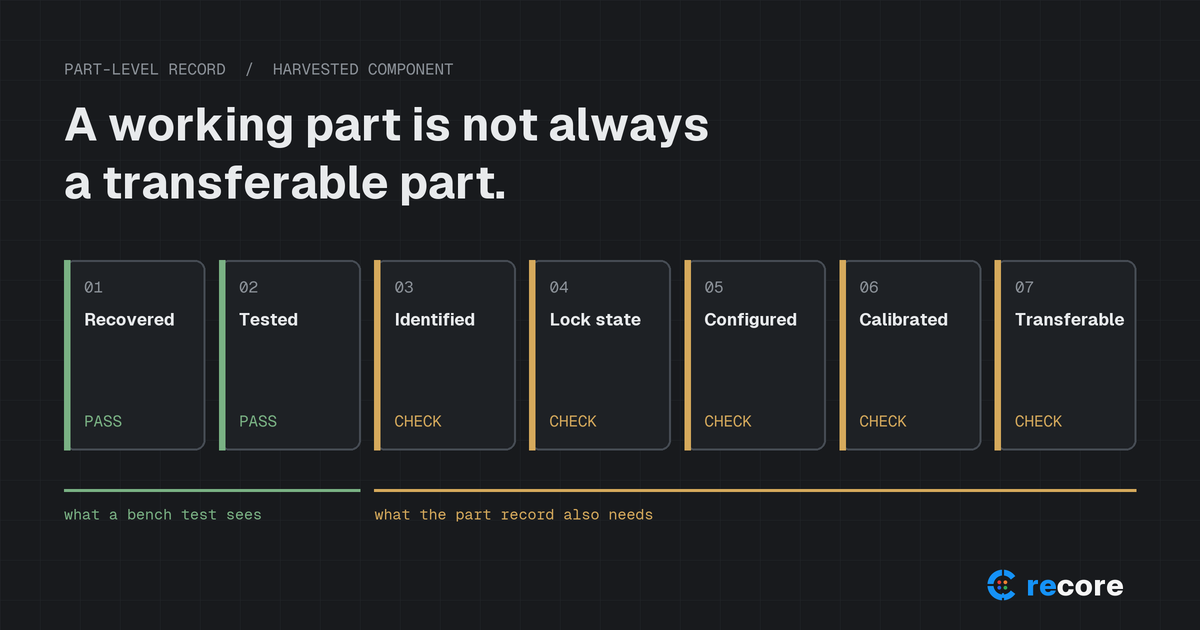
A Working Part Is Not Always a Transferable Part: Apple Parts Activation Lock and What ITAD Should Record
Apple's part-level Activation Lock and Repair Assistant change how refurbishers should test, grade and document used iPhone and iPad components.
Stay Ahead in Data Sanitization & ITAD Compliance
Join enterprise IT managers and electronics refurbishers receiving our monthly technical standards breakdowns, NIST/R2v3 audit tips, and benchmark releases.