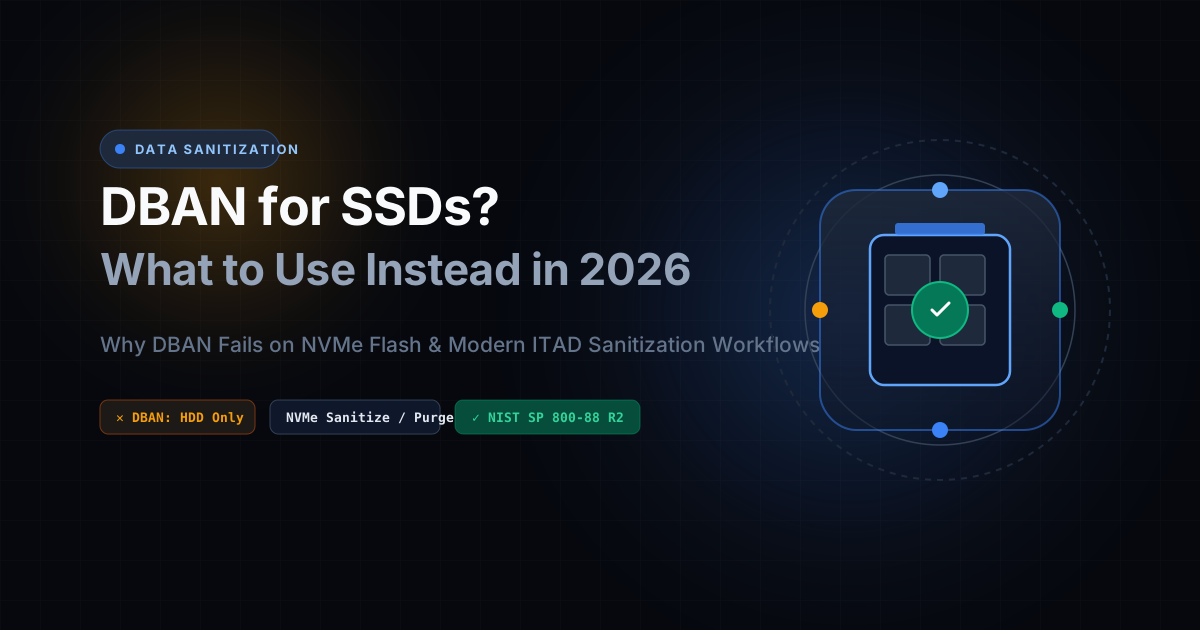
DBAN for SSDs: Does It Actually Work? What to Use Instead in 2026
Can DBAN wipe SSDs? Discover why DBAN fails on NVMe and flash storage, how NIST SP 800-88 Rev 2 and IEEE 2883 apply, and modern alternatives for ITAD operations.
If you have ever searched for a free way to wipe a computer before selling, donating, recycling, or reusing it, you have almost certainly encountered DBAN.
Darik's Boot and Nuke has been one of the best-known names in free disk wiping for decades.
But there is a fundamental problem with applying the old DBAN playbook to modern computers:
DBAN is designed for mechanical hard disk drives, not SSDs.
In fact, DBAN's official documentation explicitly confirms that DBAN is intended for personal use and does not erase SSDs. It also states that DBAN cannot guarantee complete sanitization and does not provide an auditable certificate of erasure for compliance purposes.
So if you are sitting in front of a modern laptop with an NVMe SSD and wondering:
"Can I just boot DBAN and wipe this drive?"
The answer is not the simple "yes" that many older online guides suggest.
And for an IT Asset Disposition (ITAD) operation processing hundreds or thousands of decommissioned machines, the question becomes critical:
What should you use instead, and how do you prove what happened to the device afterward?
DBAN's official documentation states: "DBAN cannot detect or erase SSDs." Attempting to run DBAN on solid-state drives will either fail to detect the drive completely (due to missing NVMe and modern AHCI drivers) or cause unnecessary write wear on flash memory without sanitizing over-provisioned blocks.
What is DBAN?
DBAN stands for Darik's Boot and Nuke.
It is an open-source, bootable floppy/CD/USB utility designed to operate independently of the host operating system. That made it popular for situations where a technician or consumer wanted to sanitize a traditional spinning hard drive before a computer was sold, donated, recycled, or repurposed.
The appeal was straightforward:
- Free: Open-source utility with zero licensing cost.
- Bootable: Runs in a lightweight Linux kernel environment outside Windows.
- Effective on HDDs: Executes basic overwrite algorithms (DoD 5220.22-M, Gutmann, PRNG Stream) across magnetic sectors.
- Simple: Self-contained for single-machine consumer disposal.
For its intended use case—spinning mechanical drives connected via legacy IDE or basic SATA—DBAN became an industry staple.
However, enterprise storage technology underwent an architectural revolution. The modern laptop or server decommissioned today contains high-density NVMe flash storage, PCIe SSDs, or soldered Apple Silicon NAND.
SSD sanitization is not simply HDD wiping with a different storage capacity.
Can DBAN Wipe an SSD?
No. Not reliably.
This is not an informal interpretation or a matter of driver tweaking.
DBAN's current project documentation explicitly states:
"DBAN cannot detect or erase SSDs."
The documentation distinguishes the free DBAN utility from Blancco's commercial Drive Eraser, which was developed to handle modern SSD, NVMe, and enterprise storage architectures.
If your computer contains an SSD, DBAN should not be treated as a valid sanitization solution.
That distinction matters because countless legacy IT tutorials still discuss DBAN as though all storage media operate identically to 1990s magnetic platters.
They do not.
Why SSDs Changed the Problem
A traditional Hard Disk Drive (HDD) stores magnetic flux transitions on rotating spinning platters.
A conventional overwrite operation is conceptually and physically direct:
Write (LBA n) ──▶ Physical Platter Sector n
You overwrite logical block 10,000, and the drive write-head physically magnetizes the exact track and sector corresponding to block 10,000.
Flash storage works on completely different physics.
An SSD does not allow the operating system to interact directly with raw NAND flash cells. Instead, an onboard micro-controller runs sophisticated firmware called the Flash Translation Layer (FTL).
The FTL continuously abstracts and manages physical flash memory through:
- Dynamic Wear Leveling: Distributing writes evenly across flash blocks to prevent uneven cell wear.
- Garbage Collection: Relocating valid data to new NAND erase blocks and clearing stale blocks in the background.
- Bad-Block Retirement: Silently remapping failing or degraded NAND blocks to internal spare pools.
- Logical-to-Physical Address Translation: A Logical Block Address (LBA) requested by the host rarely maps to the same physical NAND block across consecutive writes.
Operating System (Host)
       │  Writes to LBA 5,000
       ▼
┌────────────────────────────────────────────────────────┐
│ SSD Controller: Flash Translation Layer (FTL)          │
│ • Dynamic Wear Leveling   • Garbage Collection Pool    │
│ • Bad-Block Retirement    • Over-Provisioned Spare     │
└────────────────────────────────────────────────────────┘
       │  Remaps write to least-worn physical block
       ▼
┌───────────────────────┬────────────────────────────────┐
│ Active User Flash     │ Hidden Over-Provisioned Flash  │
│ [Block A] [Block B]   │ [Block C: Contains Old LBA Data]│
└───────────────────────┴────────────────────────────────┘
Because of this abstraction, the simplistic assumption that:
"I will write zeros or random bits to every sector"
is an incomplete and flawed model for solid-state storage. The storage controller—not the operating software—decides where data physically resides.
The Hidden Storage Problem
There is another architectural issue that becomes particularly acute with modern enterprise SSDs:
The storage capacity reported to the operating system is not the entire physical flash capacity inside the drive.
Solid-state drives contain over-provisioned storage (OP)—typically 7% to 28% of total raw NAND capacity—reserved exclusively for controller garbage collection, wear leveling, and endurance management.
These over-provisioned pools are completely inaccessible to normal host read/write commands:
- Normal host write commands (including DBAN's overwrite routines) cannot address blocks residing in the over-provisioned pool.
- If sensitive data was written to an active block that the controller subsequently marked stale and rotated into the wear-leveling reserve, that data remains physically intact inside the NAND cells.
- An attacker using chip-off forensics or direct controller firmware bypass can extract residual data from retired and over-provisioned blocks.
The NVM Express (NVMe) specification discusses this challenge directly in its definition of the Sanitize command. It emphasizes that physical flash storage exists beyond what is addressable through the host logical interface, making traditional overwrite tools fundamentally incapable of providing high-assurance sanitization.
So What Should You Use Instead?
There is no single universal drop-in utility that replaces DBAN for every scenario.
The appropriate sanitization method depends on several operational factors:
- Storage Technology: NVMe, SATA SSD, SAS, eMMC, or Apple Silicon unified storage.
- Drive Capabilities: Support for NVMe Sanitize, ATA Secure Erase, or SED hardware encryption.
- Data Classification: Commercial resale, healthcare HIPAA records, financial PII, or defense requirements.
- Target Standards: NIST SP 800-88 Rev 2, IEEE Std 2883-2022, or SERI R2v3.
- Asset Disposition: Commercial remarketing, employee redeployment, or physical destruction.
- Evidentiary Needs: Requirement for serialized, tamper-evident cryptographic audit records.
"DBAN alternative" is not a single product category.
A consumer selling a personal laptop requires a completely different approach than an enterprise ITAD facility processing 5,000 corporate devices a week.
Modern SSD Sanitization Methods
Modern solid-state storage devices support controller-native sanitization primitives. Rather than attempting to overwrite sectors over the bus, the host software instructs the SSD controller to execute hardware-level erasure:
1. NVMe Sanitize (Controller-Level Purge)
Introduced in NVMe 1.3, the dedicated Sanitize command instructs the onboard controller to make all user data completely unrecoverable across the entire non-volatile storage media:
- Block Erase: Sends a low-level electrical voltage pulse across all physical NAND flash blocks simultaneously, returning all floating-gate or charge-trap cells to an erased state. This includes user-addressable space, over-provisioned pools, and retired bad blocks.
- Crypto Erase: Changes or destroys the internal Media Encryption Key (MEK) on self-encrypting drives, rendering all previously written ciphertext computationally impossible to decrypt.
2. ATA / SCSI Secure Erase
Supported by legacy SATA and SAS drives, Secure Erase triggers internal firmware routines to clear drive mapping tables and electrically purge NAND blocks or magnetic sectors.
3. Cryptographic Erase (CE)
On Self-Encrypting Drives (SEDs) and modern platforms like Apple Silicon, user data is continuously encrypted at rest with hardware-accelerated AES-256 keys. Destroying the master media encryption key sanitizes terabytes of storage in milliseconds.
4. Physical Destruction
When drives fail sanitization commands, suffer controller lockouts, or carry classified government data, physical disintegration (shredding to 2mm or optical incineration) remains mandatory.
In September 2025, NIST published SP 800-88 Revision 2, replacing the 2014 Rev 1 framework. Revision 2 shifts the focus from rigid overwriting lists toward establishing an organizational media sanitization program. For detailed technical command mappings on solid-state media, NIST points directly to IEEE Std 2883-2022 (Standard for Sanitizing Storage).
DBAN vs. Modern SSD Sanitization
| Capability | DBAN (Legacy) | Modern SSD Sanitization (reCore) |
|---|---|---|
| Designed Media | Magnetic Spinning HDDs | NVMe, SATA SSD, SAS, Apple Silicon, HDDs |
| Boot Architecture | Legacy BIOS / MBR (Fails on modern UEFI) | Secure UEFI & PXE Network Boot |
| SSD & NVMe Support | ❌ No (explicitly unsupported) | ✅ Native NVMe Sanitize (Block & Crypto Erase) |
| Over-Provisioned Flash | ❌ Cannot reach hidden pools | ✅ Controller-native electrical flash reset |
| Enterprise Bench Scale | ❌ 1 machine at a time via manual CD/USB | ✅ Mass parallel intake across hundreds of benches |
| Verification Depth | ❌ Basic read check or none | ✅ ADISA-aligned 10% sampling to 100% full readback |
| Audit Certification | ❌ No serialized certificate | ✅ Tamper-evident PDF with SHA-256 signatures |
| Hardware Diagnostics | ❌ Erasure only | ✅ Integrated CPU, RAM, battery & thermal stress triage |
What If You Are Just Selling a Personal Laptop?
If you are a consumer wiping an individual computer before selling or donating it, you do not need an enterprise ITAD platform:
- Verify Your Storage Type: Open Windows Device Manager or macOS System Information. Check whether the storage drive is an HDD, SATA SSD, or NVMe SSD.
- If it is an HDD: DBAN can still be used if the system supports legacy BIOS boot.
- If it is a Windows SSD: Use Windows 10/11 built-in Reset ("Remove everything" → "Clean the drive"), or boot the drive manufacturer's utility (Samsung Magician, Crucial Storage Executive, Western Digital Dashboard) to trigger a native Secure Erase.
- If it is a Mac: For Apple Silicon (M1/M2/M3/M4) or Intel T2 Macs, use Erase All Content and Settings in macOS System Settings. This instantly destroys the hardware encryption keys, achieving immediate cryptographic sanitization.
However, if that laptop contains corporate data, customer records, or healthcare information, personal tools are insufficient. Regulatory compliance demands auditable, verifiable proof.
What If You Are an ITAD Company?
When processing decommissioned hardware at commercial scale, the problem changes entirely.
Scenario: 1,200 Laptops Arrive on Pallets
- 450 Dell Latitude 5420s with Kioxia NVMe SSDs
- 300 HP EliteBooks with Samsung SEDs
- 250 Lenovo ThinkPads with SATA SSDs
- 200 MacBooks with unified Apple Silicon flash
A technician cannot sit at each bench and guess:
"Which wiping utility boots on this BIOS?"
You face an intake workflow and chain-of-custody problem. The platform must automatically identify hardware architecture, execute the correct controller-level standard, verify the results, and generate proof.
       [Decommissioned Pallet Intake]
                     │
                     ▼
       ┌───────────────────────────┐
       │ Automated PXE/USB Boot    │
       └─────────────┬─────────────┘
                     │
         Auto-Detect Architecture
         ┌───────────┴───────────┐
         ▼                       ▼
    [NVMe SSD]              [SATA / SAS]
         │                       │
  NVMe Sanitize            ATA Secure Erase
  (SES-2 Crypto/Block)     or NIST Clear
         └───────────┬───────────┘
                     │
                     ▼
       ┌───────────────────────────┐
       │ Independent QA Sampling   │
       │ (10% to 100% Readback)    │
       └─────────────┬─────────────┘
                     │
                     ▼
       ┌───────────────────────────┐
       │ Serialized Audit Report   │
       │ (SHA-256 Tamper-Evident)  │
       └───────────────────────────┘
The Audit Certificate Problem
A crucial distinction often overlooked in data erasure discussions is:
Successfully executing a wiping command is not the same thing as producing auditable compliance evidence.
Under modern frameworks like SERI R2v3 Appendix B, NAID AAA, and ADISA Standard 8.0, an auditor or enterprise client requires unbroken proof binding the sanitization event to the physical serial number of the asset:
Asset Record:
  Make / Model: Dell Latitude 5420
  Asset Tag: RE-88492
  System Serial Number: 8F2K9M2

Storage Component:
  Model: Samsung PM991a NVMe 512GB
  Drive Serial: S5T2NF0MB12948
  Firmware: 2L1QFXA7

Sanitization Action:
  Standard: NIST SP 800-88 Rev 2 Purge (SES-2 Cryptographic Erase)
  Start Time: 2026-09-21 14:22:04 UTC
  Duration: 8.4 seconds
  Controller Status: 0x00 (SUCCESS)

Verification & Custody:
  Readback Verification: 10% Representative Sampling (Zero Entropy)
  QA Inspector: Tech #14 (Separation of Duties Enforced)
  Record Integrity Hash: SHA-256 (e3b0c44298fc1c149afbf4c8996fb924...)
A tool like DBAN outputs text to a local monitor screen. When power is cut, the record is gone. In an enterprise audit, an unrecorded wipe is treated as if it never occurred.
Why Scale Requires Exception Handling
Suppose 997 out of 1,000 devices successfully complete sanitization.
Three fail due to controller timeouts or bad NAND blocks.
What happens to those three machines?
- Can your software automatically lock the device status to prevent accidental release into refurbished resale inventory?
- Does the system alert the intake manager and log an exception ticket?
- Can you route those three failed drives directly to a certified physical shredding bin with an updated chain-of-custody manifest?
- Can you demonstrate to your enterprise customer exactly which serial numbers were sanitized and which were destroyed?
A basic wiping tool only answers: "Did the program execute?"
An enterprise ITAD platform must answer: "What is the complete verified disposition history of this asset?"
The Modern Replacement for DBAN Is a Unified Workflow
The data sanitization industry has outgrown standalone disk utilities.
If you are wiping a personal computer, you need a utility. If you are processing thousands of assets, you need an integrated triage and remarketing workflow.
In modern high-throughput facilities, media sanitization cannot exist in an isolated silo. While the drive is being sanitized, the technician must also:
- Benchmark CPU, GPU, and RAM stability to detect thermal throttling and bit flips.
- Check battery cycle counts and design capacity degradation.
- Record cosmetic defects (scratches, dents, screen blemishes) for secondary-market grading.
Traditional Fragmented Approach:
[Boot DBAN (Fails SSD)] ──▶ [Boot MemTest] ──▶ [Boot Windows] ──▶ [Manual Spreadsheet Grading]
(Total Time: 25–35 minutes per unit)

reCore Unified Approach:
┌────────────────────────────────────────────────────────────────────────┐
│ Single Zero-Setup Boot (<8 Minutes Total):                             │
│ 1. Instant NVMe Purge (<60s)                                          │
│ 2. Automated Silicon Stress & Diagnostic Triage                        │
│ 3. Objective Cosmetic Grading Scoring                                  │
│ 4. Serialized Tamper-Evident Manifest Generation                       │
└────────────────────────────────────────────────────────────────────────┘
Where reCore Fits
This is why reCore's ITAD platform was built from the ground up to replace fragmented legacy toolchains.
Instead of treating wiping as a disjointed manual task, reCore unifies intake into a single automated pipeline:
Device Intake ──▶ Hardware Triage ──▶ NIST Purge ──▶ QA Sampling ──▶ Grading ──▶ Certificate
- Zero-Setup Boot: Deploy instantly via lightweight USB or PXE network boot with zero on-premise servers required.
- Architecture-Aware Sanitization: Automatically identifies NVMe, SATA, SAS, and Apple Silicon, applying native NIST SP 800-88 Rev 2 Purge and IEEE 2883 methods.
- Cryptographic Tamper-Evident Records: Generates auditable certificates with drive serial numbers, firmware revisions, and SHA-256 verification hashes.
- Separation of Duties: Automatically enforces independent 5% QA sampling under SERI R2v3 Appendix B rules.
Learn how reCore replaces legacy disk utilities with high-throughput automated sanitization, stress testing, and cloud compliance reporting on our Data Wipe Feature Page, or see our reCore vs. Blancco Comparison.
Frequently Asked Questions (FAQ)
Can DBAN wipe an SSD?
No. DBAN's official documentation explicitly confirms that DBAN cannot detect or erase SSDs. It was designed exclusively for spinning magnetic hard disk drives (HDDs) and does not support modern flash controllers or wear leveling.
Can DBAN wipe an NVMe SSD?
No. DBAN cannot recognize or erase NVMe solid-state storage. NVMe devices require controller-native firmware operations, such as the NVMe Sanitize command (Block Erase or Cryptographic Erase) defined by the NVM Express specification.
What is the best modern alternative to DBAN?
There is no single universal tool for all use cases. Personal users can use drive manufacturer utilities or operating system reset options. Enterprise IT and ITAD facilities require an automated, PXE/USB bootable platform like reCore that detects drive architecture, executes NIST SP 800-88 Rev 2 and IEEE 2883 Purge, and generates tamper-evident audit certificates.
Does NIST SP 800-88 still apply in 2026?
Yes. NIST SP 800-88 Rev 2 was published in September 2025, formally superseding Revision 1 from 2014. It establishes an organizational media sanitization framework and points to standards like IEEE Std 2883-2022 for detailed storage command mappings.
Does NIST SP 800-88 require one specific SSD wiping tool?
No. NIST SP 800-88 Rev 2 focuses on establishing an organizational media sanitization program with appropriate methods and controls based on information sensitivity, pointing organizations toward approved technical standards rather than endorsing a specific proprietary utility.
Is formatting an SSD the same as securely sanitizing it?
No. Standard formatting merely rebuilds partition tables or file system headers. It leaves underlying data intact in flash cells and over-provisioned pools, making data recoverable with basic recovery software or direct NAND reading.
Is Secure Erase the same as DBAN?
No. DBAN is a legacy third-party software utility that attempts to overwrite sectors from the host. Secure Erase and NVMe Sanitize are hardware-level commands executed internally by the storage drive controller.
Does a wipe certificate prove that data was erased?
A certificate documents that a sanitization command was executed and verified. However, the cryptographic strength and audit validity of the certificate depend on serialized hardware tracking, independent QA verification, and tamper-evident SHA-256 digital signatures.
reCore Engineering
OfficialFirmware & Systems Team
Engineers building automated hardware diagnostics, PXE zero-touch boot kernels, and low-level drive sanitization engines at reCore.
Automate Testing & Evidence for R2v3 Operations
Deploy reCore across hundreds of devices simultaneously with zero-touch PXE or USB boot. Generate SHA-256 verified PDF erasure certificates with separation of duties enforcement.
Related Guides & Research
Continue exploring compliance standards, firmware sanitization, and hardware diagnostics.
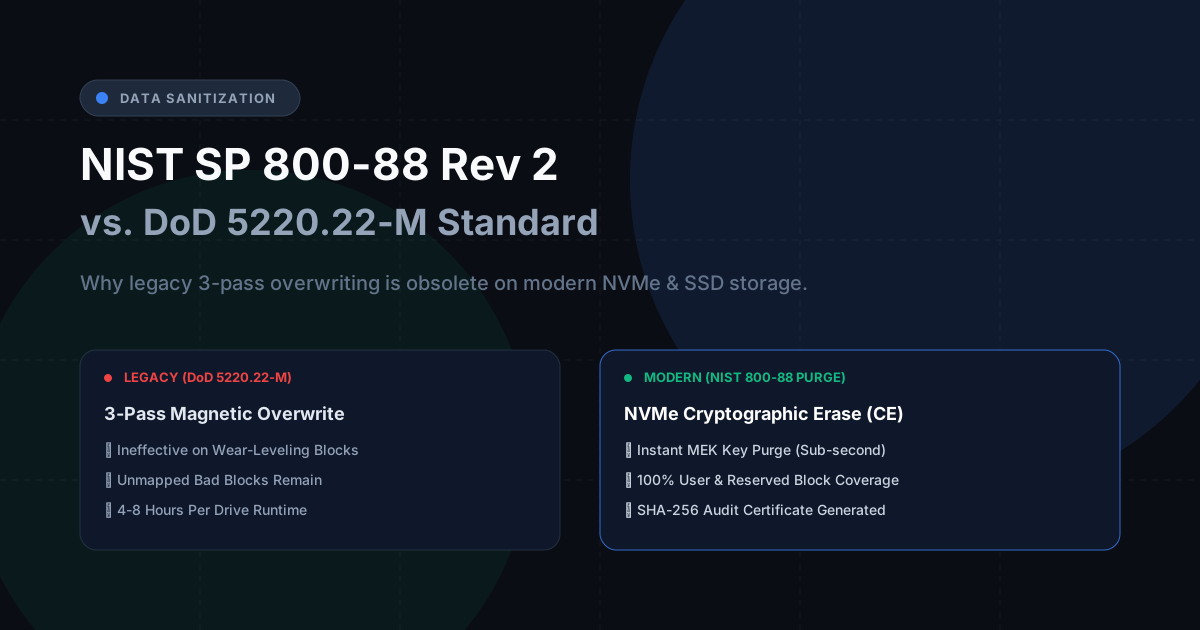
NIST SP 800-88 Rev 2 vs. DoD 5220.22-M: Modern SSD Sanitization Guide
Why DoD 5220.22-M 3-pass overwriting fails on SSD wear leveling and fails ITAD audits. How NIST SP 800-88 Rev 2 Purge sanitizes flash storage cleanly.
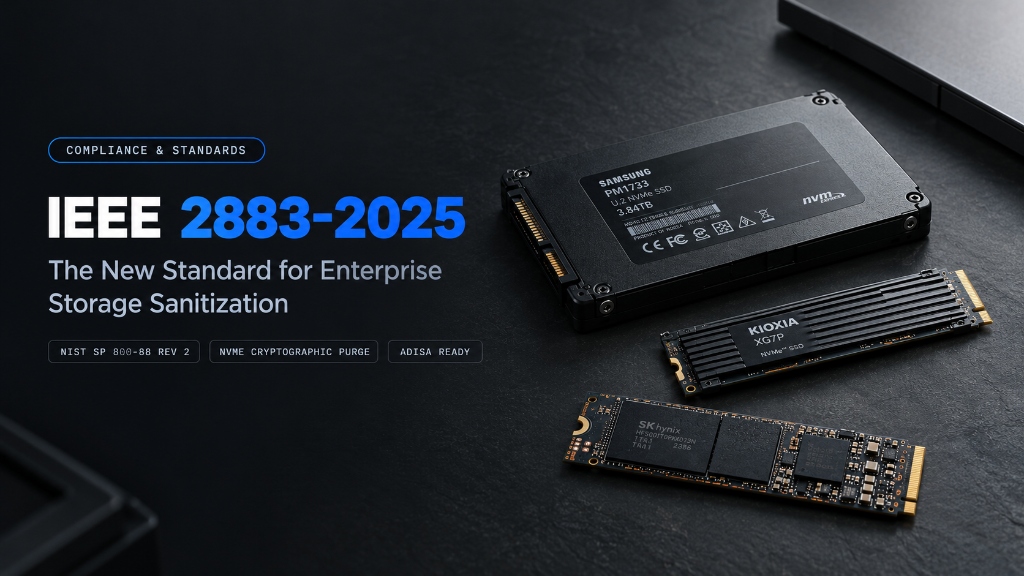
IEEE Std 2883-2022 & IEEE Std 2883.1-2025 vs. NIST SP 800-88: The Storage Sanitization Guide
Compare IEEE Std 2883-2022 vs NIST SP 800-88 Rev 2. Understand Clear, Purge, and Crypto Erase on NVMe SSDs, plus audit compliance and ADISA verification.
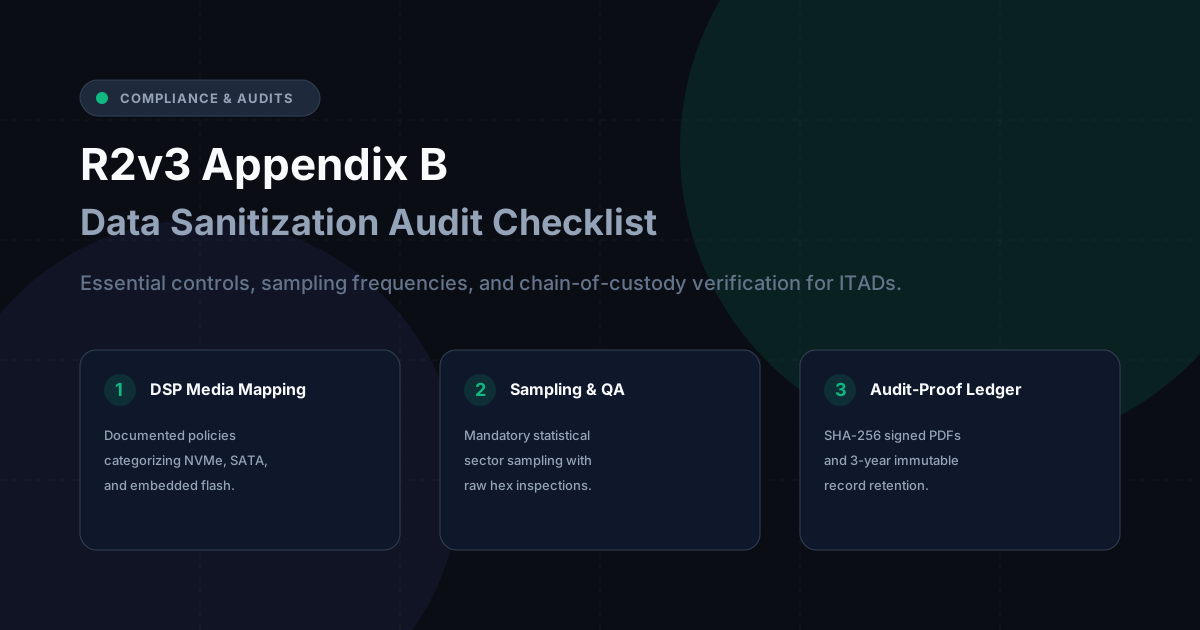
The R2v3 Appendix B Data Sanitization Audit Checklist for ITADs
Step-by-step R2v3 data sanitization audit process guide for ITADs. Master the 5% independent QA sampling rule, separation of duties, and software compliance.
Stay Ahead in Data Sanitization & ITAD Compliance
Join enterprise IT managers and electronics refurbishers receiving our monthly technical standards breakdowns, NIST/R2v3 audit tips, and benchmark releases.