IEEE 2883-2025 & IEEE 2883-2022 vs. NIST SP 800-88 Rev. 2: The Definitive Storage Sanitization Guide
A comprehensive technical guide to IEEE Std 2883-2022 and IEEE Std 2883.1-2025. Discover how modern sanitization standards address NVMe, SAS/SATA SSDs, and SEDs, and why NIST SP 800-88 is evolving.
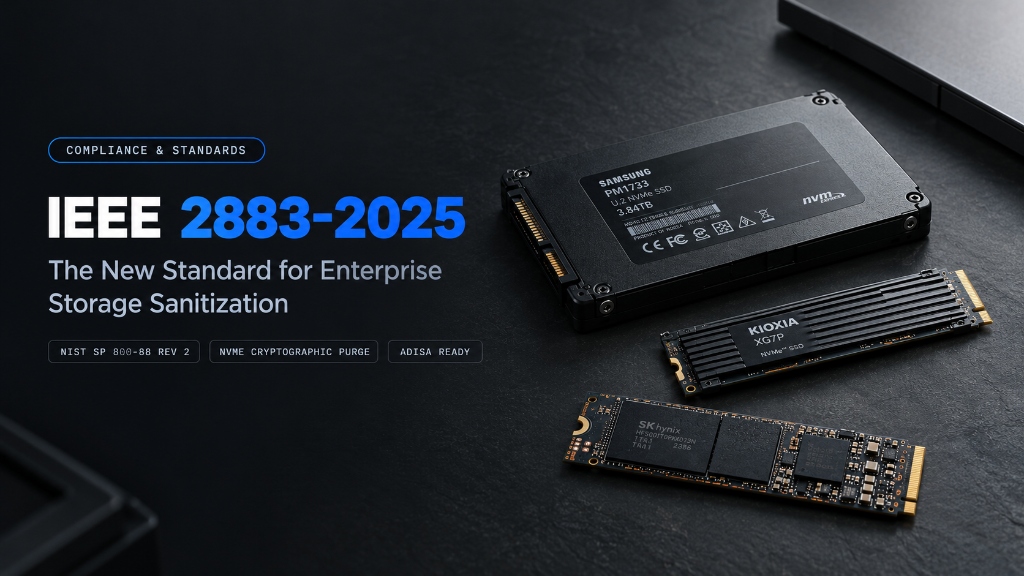
For over a decade, NIST SP 800-88 Rev. 1 (published in 2014) served as the foundational benchmark for government and enterprise media sanitization. However, the last ten years brought radical shifts in solid-state architecture—including multi-terabyte NVMe drives, Zoned Namespaces (ZNS), Computational Storage, and pervasive hardware-level encryption (SEDs).
To address modern storage interfaces and solid-state physics, the IEEE Standards Association published IEEE Std 2883™-2022 (Standard for Sanitizing Storage), followed by IEEE Std 2883.1™-2025 (Recommended Practice for Use of Storage Sanitization Methods).
Together with the upcoming NIST SP 800-88 Rev. 2 updates, IEEE 2883 represents the definitive modern standard for IT Asset Disposition (ITAD), cloud datacenters, and enterprise data lifecycle management.
Unlike legacy standards that treat solid-state media like spinning hard drives, IEEE 2883-2022 and IEEE 2883.1-2025 define exact firmware commands, cryptographic key purges, and verification sampling criteria tailored specifically for modern NVMe, U.2/U.3, SATA SSDs, and optical media.
Why NIST SP 800-88 Needed Modernization
When NIST SP 800-88 Rev. 1 was drafted in 2014, magnetic spinning disks (HDDs) still comprised the vast majority of enterprise storage. Solid-state drives were treated as an emerging subsection.
Modern enterprise flash presents fundamental physical barriers to traditional magnetic wiping methods:
- Flash Translation Layer (FTL) Abstraction: The operating system addresses Logical Block Addresses (LBAs), but the internal drive controller dynamically remaps writes across physical NAND flash blocks.
- Hidden Over-Provisioned Capacity: SSDs contain between 7% and 28% unmapped flash capacity used for wear leveling and garbage collection. Logical sector-by-sector overwriting cannot reach these areas.
- Retired Bad Blocks: When a NAND page develops marginal read errors, the controller retires it from active use. Sensitive raw data remains trapped inside retired blocks, accessible only via laboratory chip-off recovery.
- Hardware Encryption Controllers: Modern enterprise SSDs encrypt all incoming data using hardware-embedded Media Encryption Keys (MEKs) by default.
NIST SP 800-88 vs. IEEE 2883-2022 / IEEE 2883.1-2025 Comparison
While NIST SP 800-88 and IEEE 2883 share similar high-level principles (Clear, Purge, Destroy/Destruct), IEEE 2883 provides far more granular technical requirements for modern interfaces.
| Feature / Dimension | NIST SP 800-88 Rev. 1 (2014) | IEEE Std 2883-2022 / 2883.1-2025 |
|---|---|---|
| Release Year | 2014 (Legacy baseline) | 2022 / 2025 (Modern standard) |
| NVMe 1.4+ & 2.0 Native Commands | Generic guidance | Explicit Sanitize & Format command mappings |
| SSD Over-Provisioning & Wear Pools | High-level mention | Strict requirement for controller-level Purge |
| Cryptographic Erase (CE) | Optional subset of Purge | Formally defined with key revocation validation |
| Zoned Namespaces (ZNS) & NVMe-oF | Not covered | Fully addressed |
| Post-Wipe Verification Rules | Suggested sampling | Statistically required hex & entropy verification |
| Audit Readiness (R2v3 / ADISA) | Recognized baseline | Mandatory for modern high-security ITAD audits |
How IEEE 2883 Purge Works on NVMe Storage
Under IEEE 2883, Purge is the required standard when storage media will be reused outside the organization's physical control (such as resale, remarketing, or lease returns).
On modern NVMe and U.2/U.3 enterprise drives, reCore executes IEEE 2883 Purge through native hardware controller commands:
1. Cryptographic Erase (Crypto Scramble)
On Self-Encrypting Drives (SEDs), the SSD controller continuously encrypts all data using an internal Media Encryption Key (MEK). When executing a Cryptographic Purge:
- The host issues an NVMe
Sanitizecommand with the Crypto Scramble action (--sanact=0x4). - The controller instantly overwrites and deletes the internal encryption key with high-entropy pseudo-random noise.
- All data on the NAND flash—including active LBAs, hidden wear-leveling pools, and retired blocks—instantly transforms into computationally indecipherable ciphertext.
# Executing native NVMe Sanitize Crypto Scramble under IEEE 2883
nvme sanitize /dev/nvme0n1 -a 0x4 --report
2. Block Erase
For non-encrypted solid-state storage, IEEE 2883 Purge utilizes low-level Block Erase:
- The host issues an NVMe
SanitizeBlock Erase command (--sanact=0x2). - The controller applies a low-level electrical voltage pulse to all NAND flash memory cells across every block, setting every cell back to its unprogrammed physical state (
0xFFor0x00).
# Executing native NVMe Sanitize Block Erase under IEEE 2883
nvme sanitize /dev/nvme0n1 -a 0x2 --report
Executing native firmware Purge commands via IEEE 2883 takes seconds to minutes compared to hours of legacy multi-pass overwrites, while preserving the write endurance (TBW) of the SSD.
Verification & Audit Requirements for Enterprise ITAD
Passing an R2v3, ADISA, e-Stewards, or SOC 2 Type II audit requires verifiable proof that sanitization occurred according to standard operating procedures.
Under IEEE Std 2883.1-2025 and R2v3 Appendix B, every sanitization job must satisfy three validation checkpoints:
- Firmware Status Inspection: Confirming the drive controller returned
Sanitize Status: Success (0x0000)with 0 failed sectors. - Statistically Valid Sector Sampling: Performing automated byte-level read checks across at least 10% to 100% of logical block addresses to verify zero-entropy or expected bit patterns.
- Cryptographically Signed Certificate: Generating a tamper-proof PDF / JSON certificate containing:
- Drive serial number, vendor, model, and firmware revision.
- Method executed (
IEEE 2883-2022 Purge (Crypto Scramble)). - Host station UUID, technician ID, timestamp, and verification hash.
Frequently Asked Questions (FAQ)
Is NIST SP 800-88 being replaced by IEEE 2883?
NIST SP 800-88 and IEEE 2883 are complementary standards. The NIST working group is aligning NIST SP 800-88 Rev. 2 with the technical definitions in IEEE 2883-2022 and IEEE 2883.1-2025. For enterprise ITAD and modern NVMe/SSD sanitization, IEEE 2883 provides the most specific and up-to-date technical instructions.
Why is DoD 5220.22-M obsolete for SSDs?
DoD 5220.22-M was designed in 1995 for magnetic platter drives and requires 3 sequential overwrite passes. Because SSD controllers remap writes across wear-leveling pools, multi-pass overwriting wears out NAND flash unnecessarily without guaranteeing erasure of hidden or retired blocks. Both NIST and IEEE advise against DoD 5220.22-M on solid-state drives.
Does reCore support IEEE 2883-2022 / IEEE 2883-2025 sanitization?
Yes. reCore's automated wipe engine detects drive architecture (NVMe, SATA, SAS, Apple Silicon, SED) and executes certified IEEE 2883 Clear and Purge protocols, generating tamper-proof, audit-ready certificates for R2v3, ADISA, and SOC 2 compliance.
reCore Engineering
OfficialDiagnostics & Standards Group
Official technical research, guides, and engineering updates from the reCore team.
Automate NIST SP 800-88 & R2v3 Compliance
Deploy reCore across hundreds of devices simultaneously with zero-touch PXE or USB boot. Generate SHA-256 verified PDF erasure certificates with separation of duties enforcement.
Related Guides & Research
Continue exploring compliance standards, firmware sanitization, and hardware diagnostics.
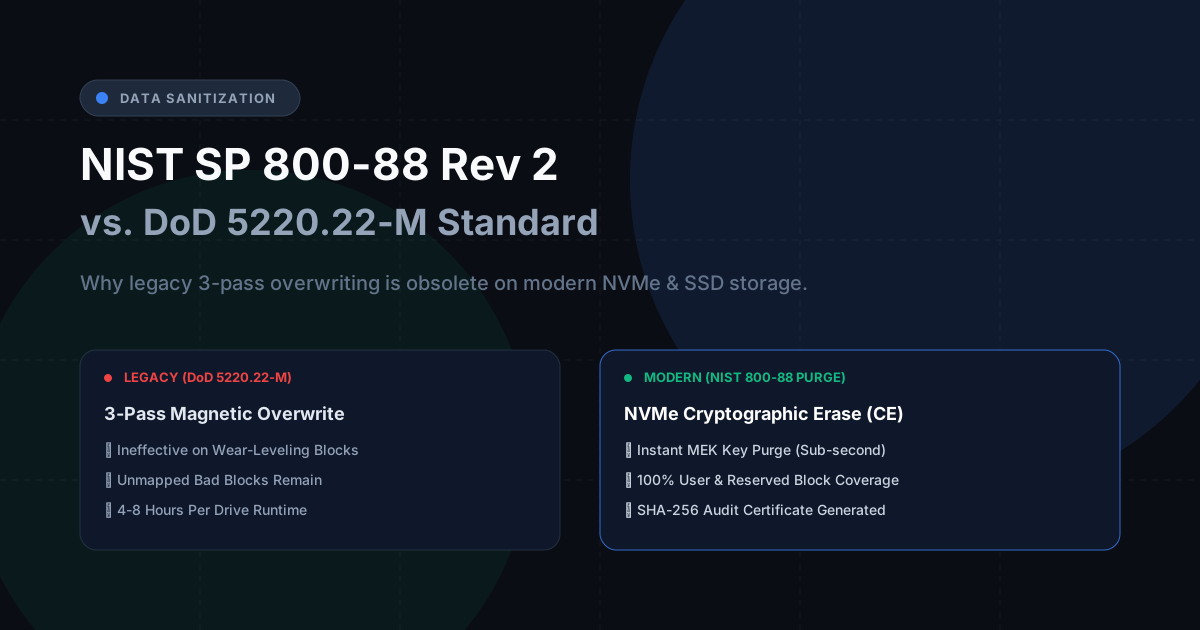
NIST SP 800-88 Rev 2 vs. DoD 5220.22-M: The Modern ITAD Sanitization Guide
Why the legacy DoD 5220.22-M 3-pass standard is obsolete on modern flash media and how NIST SP 800-88 Clear vs. Purge fulfills enterprise ITAD compliance.
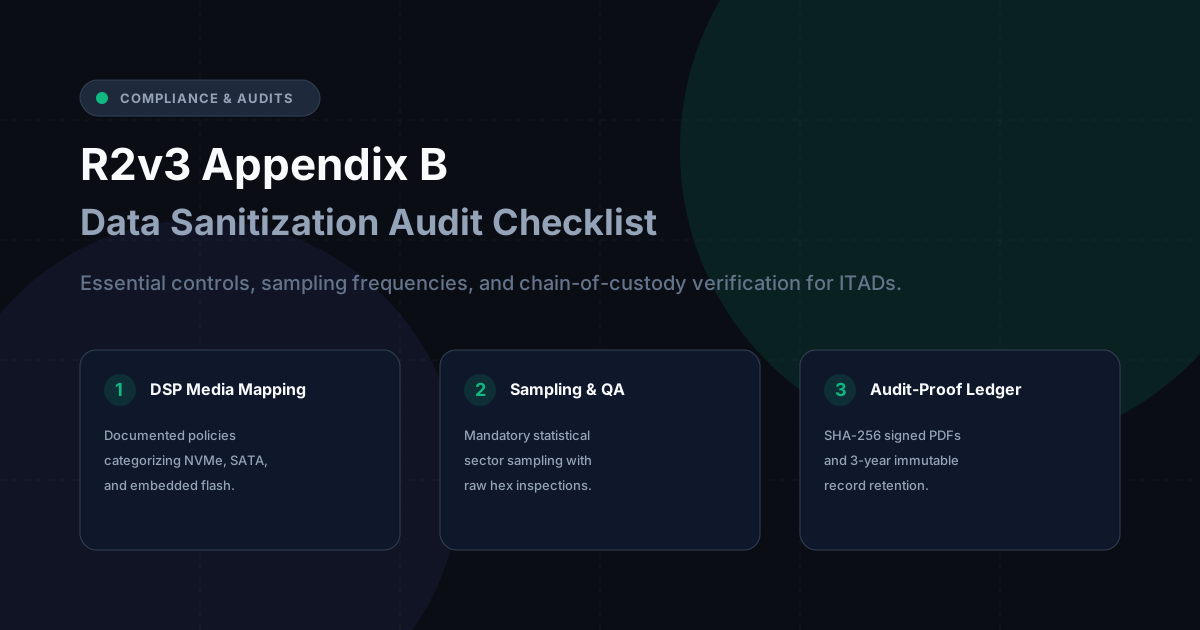
The R2v3 Appendix B Data Sanitization Audit Checklist for ITADs
A comprehensive compliance roadmap for electronics recyclers and ITAD facilities preparing for SERI R2v3 Appendix B data sanitization audits.
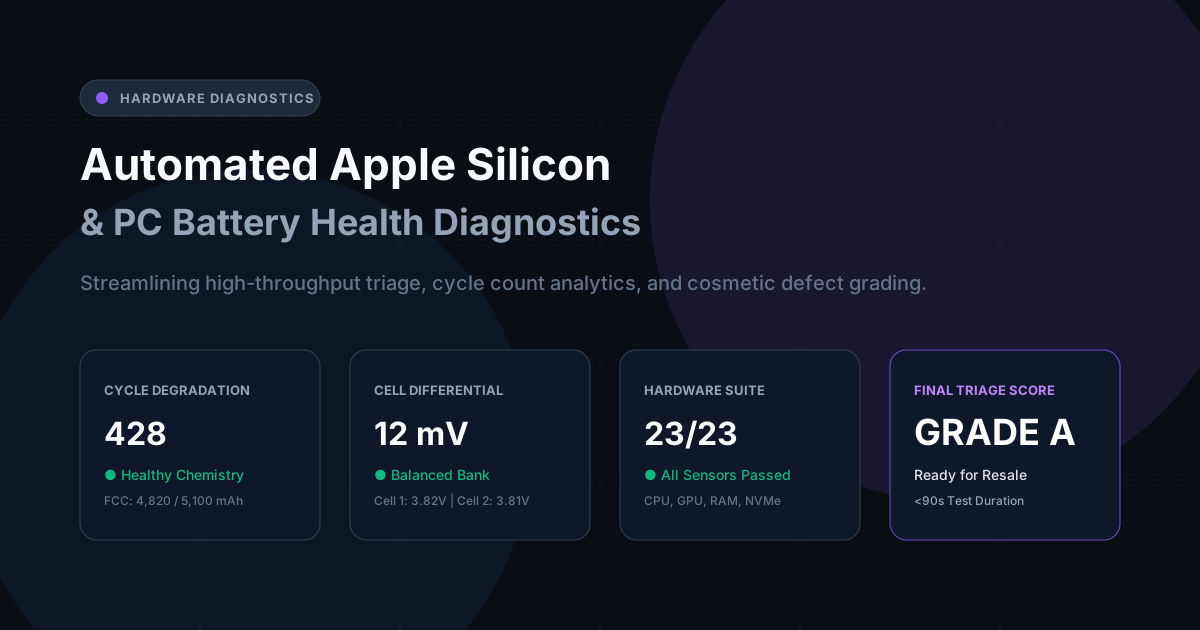
Automated Apple Silicon & PC Battery Health Diagnostics in Refurbishing Batches
How automated hardware diagnostics, cycle count tracking, and battery health degradation algorithms streamline triage for high-volume ITAD processors.
Stay Ahead in Data Sanitization & ITAD Compliance
Join enterprise IT managers and electronics refurbishers receiving our monthly technical standards breakdowns, NIST/R2v3 audit tips, and benchmark releases.