The Windows 10 ESU Escalation: A 4-Channel ITAD Triage Framework for Non-Windows 11 Hardware
Microsoft Windows 10 ESU costs double in Year 2. Discover how ITAD facilities use automated hardware diagnostics to triage off-lease fleets across 4 commercial channels.
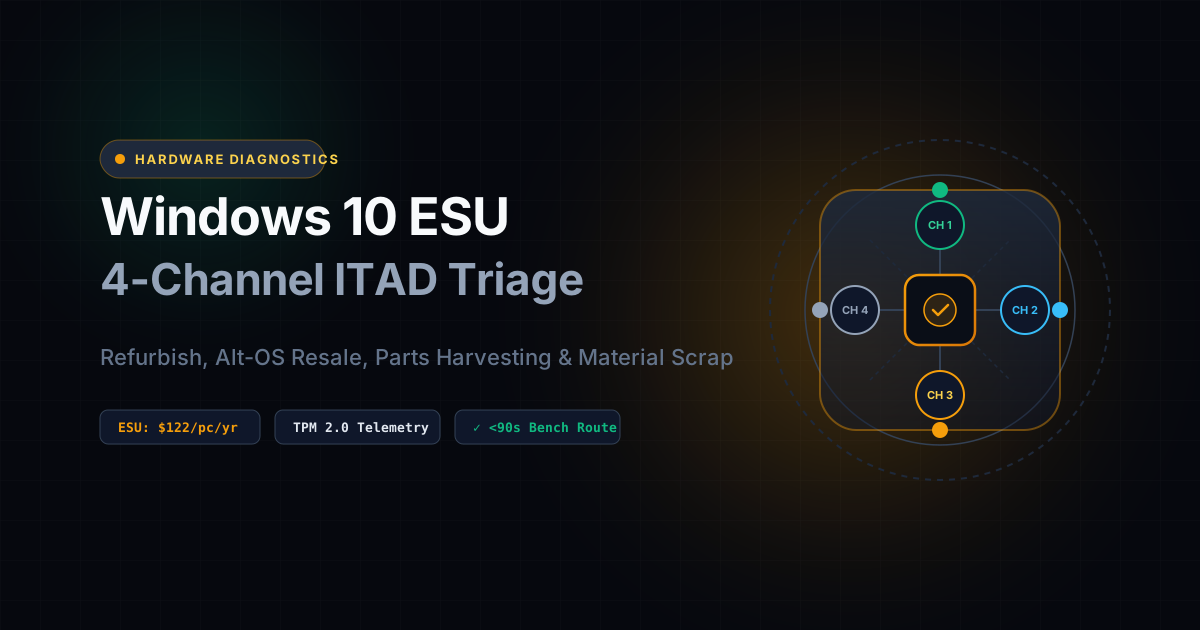
When mainstream support for Windows 10 concluded on October 14, 2025, it marked the beginning of an operational transition for IT asset disposition (ITAD) facilities, enterprise asset managers, and commercial refurbishers.
For many corporate IT departments, the immediate bridge was Microsoft's Extended Security Updates (ESU) program. However, the commercial ESU structure was designed as a temporary transition mechanism rather than a permanent operational strategy.
As Year 1 ESU ($61 USD per device) approaches its renewal window and transitions to Year 2 ($122 USD per device), the economics of keeping non-upgradable fleets on corporate ledgers deteriorate rapidly. For standard enterprise desktops and laptops from the Intel 6th and 7th Generation eras, paying $122 per seat for a second year of security patches exceeds the residual wholesale value of the physical device.
The consequence for ITAD processing facilities is a sustained influx of functional, off-lease enterprise hardware that cannot officially run Windows 11.
Treating these machines as uniform e-waste destroys commercial value. Treating them as traditional Windows refurbishments leads to downstream customer rejections.
Managing this volume profitably requires an objective, automated 4-Channel Triage Framework.
The Windows 10 support conclusion is an asset routing decision, not a mass-disposal order. The challenge for ITAD facilities is deploying automated bench diagnostics to determine an asset's optimal disposition channel in under 90 seconds.
1. The Economic Reality of Windows 10 ESU Pricing Escalation
The commercial ESU pricing model doubles every twelve months and enforces strict cumulative billing rules:
| ESU Lifecycle Window | Commercial Base Price (Per Device) | Cloud-Managed Intune Rate | Cumulative Minimum Cost (Year-to-Date) | Economic Impact on Off-Lease Fleets |
|---|---|---|---|---|
| Year 1 (Oct 2025 – Oct 2026) | $61 USD | $45 USD | $61 USD | Manageable transition bridge for active corporate fleets. |
| Year 2 (Oct 2026 – Oct 2027) | $122 USD | $90 USD | $183 USD | ESU cost eclipses residual wholesale value of 6th/7th Gen assets. |
| Year 3 (Oct 2027 – Oct 2028) | $244 USD | $180 USD | $427 USD | Total software extension exceeds original refurbished acquisition cost. |
When an enterprise faces a $122-per-seat charge to maintain an aging Intel Core i5-7200U laptop with a wholesale value of $75, the financial decision is obvious: decommission the fleet, capture the remaining residual recovery value through ITAD consignment, and deploy new hardware.
This economic dynamic guarantees that ITAD facilities will process high volumes of non-Windows 11 hardware throughout 2026 and 2027.
2. The Hardware Compatibility Boundary
The dividing line between standard remarketing and specialized triage is established by Microsoft's Windows 11 hardware baseline:
| Hardware Component | Windows 11 Minimum Requirement | Primary Failure Point in Retired Fleets | ITAD Detection Method |
|---|---|---|---|
| Processor Architecture | Supported 64-bit CPU (Intel 8th Gen+ / AMD Zen 2+) | Intel 6th & 7th Gen Core (Skylake, Kaby Lake), AMD Zen 1 | CPUID / Microarchitecture query via bare-metal boot. |
| Cryptographic Module | TPM Version 2.0 (Discrete or Firmware fTPM) | Systems with TPM 1.2 or disabled/unprovisioned fTPM | ACPI table probe and TPM TCG capability handshake. |
| Firmware Environment | UEFI with Secure Boot capability | Legacy BIOS configurations or MBR partition layouts | Firmware interface query during OS bootstrap. |
| System Memory | Minimum 4 GB (8 GB+ operational standard) | Single-channel 4 GB configurations requiring upgrades | Automated SPD memory bus interrogation. |
| Storage Capacity | Minimum 64 GB storage drive | Healthy drive capacity vs. high sector wear | NVMe / SATA controller query and SMART wear analysis. |
Assets that satisfy all five criteria qualify for premium commercial refurbishment. Assets failing one or more criteria must be systematically evaluated against alternative value channels.
3. The 4-Channel Operational Triage Framework
To prevent intake bottlenecks, facilities should organize their sorting and bench operations into four clear disposition channels:
| Disposition Channel | Hardware Eligibility Criteria | Operational Processing Required | Primary Downstream Market |
|---|---|---|---|
| Channel 1: Windows 11 Refurbishment | Intel 8th Gen+ / AMD Zen 2+, TPM 2.0 active, UEFI Secure Boot, Battery >75% health. | Full diagnostic burn-in, NIST/IEEE storage sanitization, deterministic cosmetic grading, OS preload. | Tier-1 B2B wholesale, corporate redeployment, premium consumer resale. |
| Channel 2: Alternative OS Remarketing | Intel 6th/7th Gen, TPM 1.2 or 2.0, Dual-Core 2.0GHz+, healthy display/chassis, Storage healthy. | Storage sanitization, automated hardware diagnostics, certified Linux or ChromeOS Flex image deployment. | Educational institutions, SMBs, call centers, international secondary markets. |
| Channel 3: Sub-Assembly Harvesting | Failed mainboard, defective display, or cosmetically degraded chassis (Grade D/F) with functional internal modules. | Disassembly, automated component-level testing (RAM patterns, NVMe health, battery cycle validation), SKU inventory. | Spare parts distributors, in-house repair bench inventory, third-party repair networks. |
| Channel 4: Material Recovery (Recycling) | Severe physical fracture, motherboard liquid damage, obsolete DDR3/HDD platforms, non-repairable faults. | Mechanical dismantling, hazardous battery extraction, commodity sorting, R2v3/e-Stewards downstream refining. | Certified scrap processors, smelters, circular raw material recovery. |
Channel 1: Native Windows 11 Enterprise Refurbishment
Assets routed to Channel 1 command the highest average selling prices (ASPs) in the secondary market. Because these devices satisfy all Windows 11 baselines, they can be deployed directly into corporate and enterprise environments without software longevity concerns. For high-volume facilities, navigating this transition at scale is detailed in our guide on The 240-Million-PC Transition & Automated Testing.
Bench Runbook:
- Interrogate CPU generation and verify active TPM 2.0.
- Execute full hardware diagnostic battery (CPU stress, RAM patterns, display, ports, battery capacity).
- Execute controller-native storage sanitization aligned with NIST SP 800-88 Rev. 2 and IEEE 2883-2022 protocols.
- Calculate deterministic cosmetic grade based on measured chassis tolerances.
- Apply digital signature to asset processing record and stage for commercial wholesale.
Channel 2: Alternative Operating System Remarketing
The greatest risk of margin loss occurs when operators treat fully functional 6th and 7th Gen Intel systems as scrap. Equipped with 8 GB of RAM and a solid-state drive, an Intel Core i5-7200U laptop provides sufficient performance for cloud-based web workflows, call centers, and general administration.
When deployed with enterprise-supported Linux distributions (e.g., Ubuntu LTS) or cloud-first operating systems such as ChromeOS Flex, these devices operate securely without requiring Microsoft ESU subscriptions.
Bench Runbook:
- Verify storage and memory health via automated telemetry.
- Verify battery full charge capacity remains above defined commercial resale threshold (e.g., >70%).
- Execute standards-compliant media purge to ensure complete data destruction (avoiding obsolete methods like DBAN on modern SSDs).
- Deploy standardized secondary OS image or prepare for bare-metal wholesale with verified hardware diagnostic certificates.
Channel 3: Precision Sub-Assembly and Component Harvesting
When an incoming asset suffers from a non-viable form factor defect (e.g., cracked top lid, broken hinges, severe enclosure dents) or a defective motherboard, the individual sub-assemblies often retain significant commercial value.
The global repair ecosystem faces continuous demand for OEM-original spare parts:
| Extracted Sub-Assembly Component | Specification Benchmark | Secondary Market Value Realization |
|---|---|---|
| DDR4 SODIMM Module | 8 GB / 16 GB PC4-2400 / 2666 / 3200 | $12 - $22 USD per module |
| M.2 NVMe SSD | 256 GB / 512 GB PCIe Gen3 x4 (Sanitized) | $14 - $26 USD per drive |
| 14.0" FHD IPS Display Panel | 1920x1080 Non-Touch / eDP 30-Pin | $25 - $45 USD (Tested zero pixel defects) |
| OEM Internal Battery Pack | Validated $\ge 80%$ Full Charge Capacity | $15 - $25 USD (Low cycle count) |
| Dual-Band Wi-Fi 5/6 Module | Intel Wireless-AC 8265 / AX200 | $3 - $6 USD per card |
| Total Harvested Yield per Unit | Combined modular salvage value | $69 - $124 USD |
| Bulk Scrap Value of Complete Unit | Unprocessed whole-unit shredding rate | $8 - $12 USD |
Harvesting components profitably requires testing the modules before dedicating labor to teardown. Testing RAM, NVMe health, and battery degradation while the components remain in the intact chassis prevents technicians from wasting bench time extracting degraded parts. Full asset-level provenance can then be tracked using Hardware Lifecycle Traceability Records.
Channel 4: Certified Material Recovery and Recycling
Assets routed to Channel 4 have reached the end of their functional utility. Under certified operational standards such as SERI R2v3 and e-Stewards, material recovery must follow strict chain-of-custody and environmental controls. Review our R2v3 Data Sanitization & Audit Guide for downstream compliance expectations.
Key Requirements:
- Lithium-ion batteries must be carefully removed, terminals insulated, and routed to certified battery recyclers.
- Storage media that fails electronic sanitization (e.g., inaccessible controller, bad block threshold exceeded) must be transferred to physical destruction (shredding or degaussing where applicable) with serial-level tracking.
- Printed circuit boards (motherboards, daughterboards) are separated for precious metal refining (gold, silver, palladium, copper).
- Plastics and chassis metals (aluminum, magnesium alloys) are granulated for secondary smelter feedstock.
4. Key Diagnostic Metrics That Determine Channel Assignment
Making triage decisions manually by navigating BIOS menus is too slow for commercial ITAD volumes. High-throughput facilities rely on automated diagnostic telemetry captured directly during bare-metal boot:
| Telemetry Parameter | Threshold for Channel 1 (Win 11) | Threshold for Channel 2 (Alt OS) | Trigger for Channel 3 (Harvest) | Trigger for Channel 4 (Scrap) |
|---|---|---|---|---|
| CPU Architecture | Intel 8th Gen+ / AMD Zen 2+ | Intel 6th/7th Gen / AMD Zen 1 | Any supported architecture | Obsolete architecture / Dead SoC |
| TPM Version | TPM 2.0 (Enabled) | TPM 1.2 or 2.0 | Irrelevant to component value | Failed controller / Inoperable |
| Memory Capacity | 8 GB or higher (or open SODIMM slot) | 4 GB or higher (Expandable) | Individual SODIMM passes test | Failed soldered onboard RAM |
| Storage Health | NVMe/SATA 20% or less wear, 0 bad blocks | Drive passes 100% read-back | Drive passes sanitize & test | Drive fails sanitization/bad blocks |
| Battery Health | 75% or higher Full Charge Capacity | 65% or higher Full Charge Capacity | 70% or higher Capacity (Extract pack) | Swollen / Defective / under 50% |
| Display Quality | Grade A/B (No pressure marks/lines) | Grade B/C (Minor blemishes) | Panel tested pristine / working | Cracked / Delaminated / Broken |
5. Where reCore Fits Into High-Velocity Fleet Triage
reCore by ReplugIT provides the operational technology layer that executes this triage framework at scale.
Rather than relying on manual technician inspection, reCore operates directly in automated bare-metal environments (via Zero-Setup Network PXE Boot or rapid USB media):
- Automated Hardware Interrogation: Immediately queries CPU microcode, TPM revision, system UUID, and memory topologies upon boot through Automated Diagnostics.
- Controller-Native Storage Sanitization: Executes standards-compliant Clear and Purge sanitization commands mapped to NIST SP 800-88 Rev. 2 and IEEE 2883-2022 protocols via Hybrid Wipe.
- Component-Level Burn-In: Performs concurrent stress testing on CPU cores, memory matrices, storage media, and battery degradation without requiring an installed operating system.
- Deterministic Grading Engine: Applies customizable rules to map measured hardware telemetry and technician cosmetic inputs to objective, repeatable grades with Deterministic Grading.
- Tamper-Evident Processing Ledgers: Generates exportable records binding hardware serials, diagnostic findings, and sanitization proofs into a unified Cloud Management Dashboard.
reCore does not determine Microsoft licensing eligibility or provide official compliance certifications. It provides the bench-level execution engine and evidence-capture infrastructure that allows ITAD operators to enforce their own triage policies rapidly and consistently.
6. Operational Checklist for Intake Technicians
To maximize throughput and prevent misrouting, intake benches should enforce the following standard operating procedure:
- Connect Asset to Network PXE Bay: Boot directly into automated diagnostic environment without booting local storage.
- Review Automated Architecture Flags: Verify whether the system flags Windows 11 compatibility (CPU Gen + TPM 2.0).
- Execute Automated Storage Sanitization: Trigger background purge command while diagnostic battery executes.
- Inspect Display and Input Matrix: Complete guided 20-second technician validation of screen backlight, keyboard matrix, and external ports.
- Evaluate Battery Capacity Metric: Check automated full charge capacity report against facility resale threshold.
- Apply Automated Disposition Route: Print routing barcode label with deterministic grade and assigned disposition channel (Channel 1, 2, 3, or 4).
- Stage Asset for Destination Workflow: Move asset immediately to OS imaging, secondary packaging, parts harvesting bench, or recycling bin.
Authoritative References
- Microsoft Corporation
Windows 10 End of Support and Extended Security Updates (ESU) Guidance
Official Policy Documentation: Published October 2025.
Resource:learn.microsoft.com - Microsoft Corporation
Windows 11 Minimum Hardware Requirements & Supported Processor Specifications
Resource:learn.microsoft.com/windows-hardware/design/minimum/windows-processor-requirements - National Institute of Standards and Technology (NIST)
Guidelines for Media Sanitization (NIST SP 800-88 Revision 2)
Published: September 26, 2025. - IEEE Standards Association
IEEE Standard for Sanitizing Storage (IEEE Std 2883-2022)
Published: August 2022. - International Telecommunication Union (ITU) / UNITAR
Global E-waste Monitor 2024: Quantifying Global E-waste Flows and Circular Economy Opportunities
Published: March 2024. - Canalys Research
PC Market Pulse: Assessing the Windows 10 Installed Base and Refurbishment Dynamics
Published: December 2023.
reCore Engineering
OfficialFirmware & Systems Team
Engineers building automated hardware diagnostics, PXE zero-touch boot kernels, and low-level drive sanitization engines at reCore.
Automate Testing & Evidence for R2v3 Operations
Deploy reCore across hundreds of devices simultaneously with zero-touch PXE or USB boot. Generate SHA-256 verified PDF erasure certificates with separation of duties enforcement.
Related Guides & Research
Continue exploring compliance standards, firmware sanitization, and hardware diagnostics.
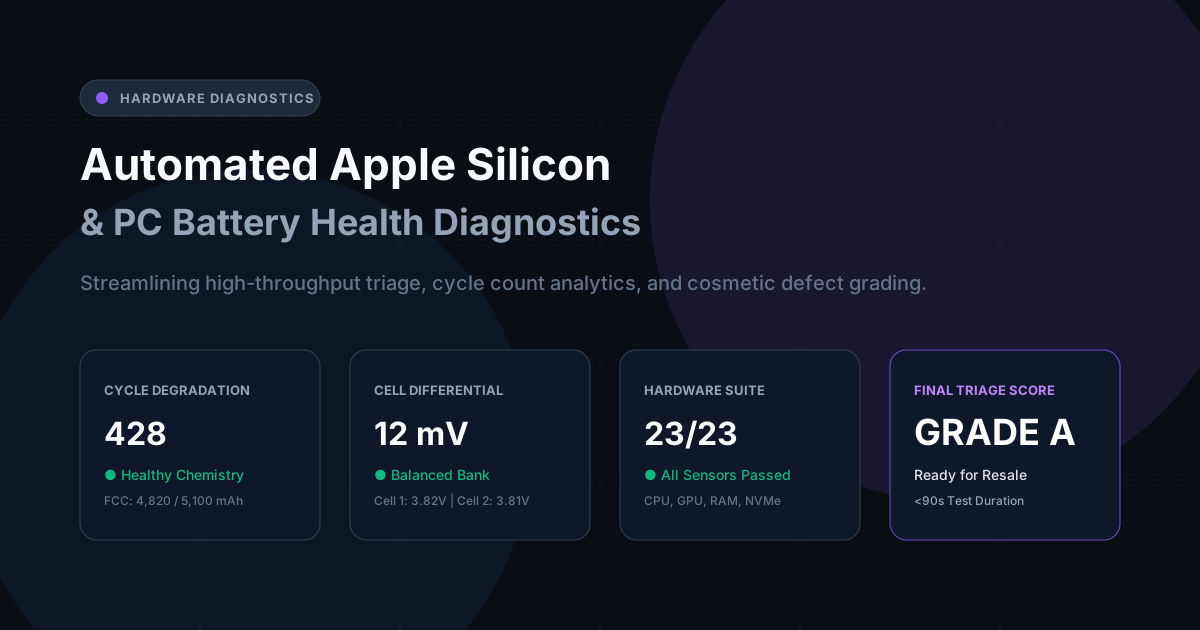
Automated Apple Silicon & PC Battery Health Diagnostics in Refurbishing Batches
How automated hardware diagnostics, cycle count tracking, and battery health degradation algorithms streamline triage for high-volume ITAD processors.
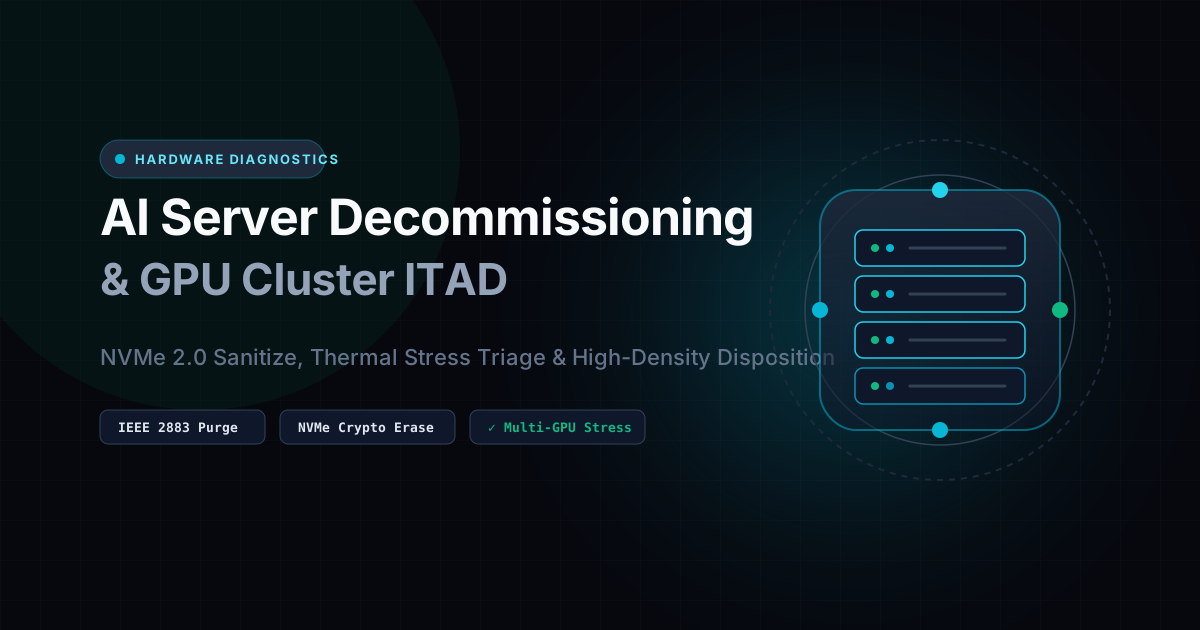
The 18-Month AI Server Lifecycle: Why GPU Cluster Decommissioning Demands a New ITAD Playbook
With accelerated compute lifecycles compressed to 18-36 months, GPU nodes lose 40% of value in 60 days. Learn modern NVMe 2.0 sanitization and thermal triage.
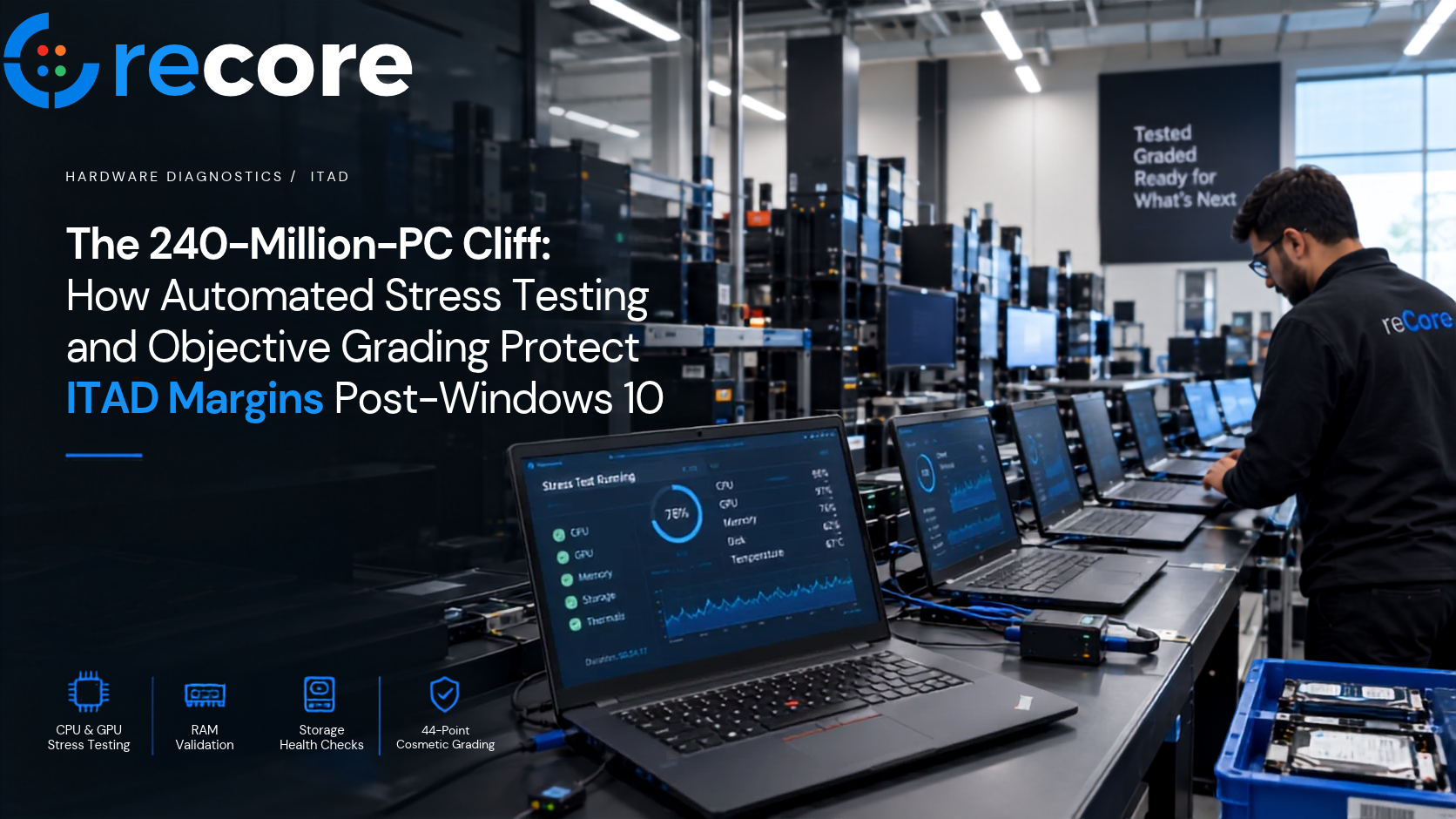
The 240-Million-PC Transition: How Automated Hardware Testing and Objective Grading Protect ITAD Margins Post-Windows 10
Windows 10 EOL is driving a major PC refresh wave. Learn how ITADs can use automated diagnostics, stress testing, data sanitization and objective grading to process more devices and protect resale margins.
Stay Ahead in Data Sanitization & ITAD Compliance
Join enterprise IT managers and electronics refurbishers receiving our monthly technical standards breakdowns, NIST/R2v3 audit tips, and benchmark releases.