The Hardware Lifecycle Is Becoming Traceable: What ITAD Needs to Know About Digital Product Passports and NIST IR 8536
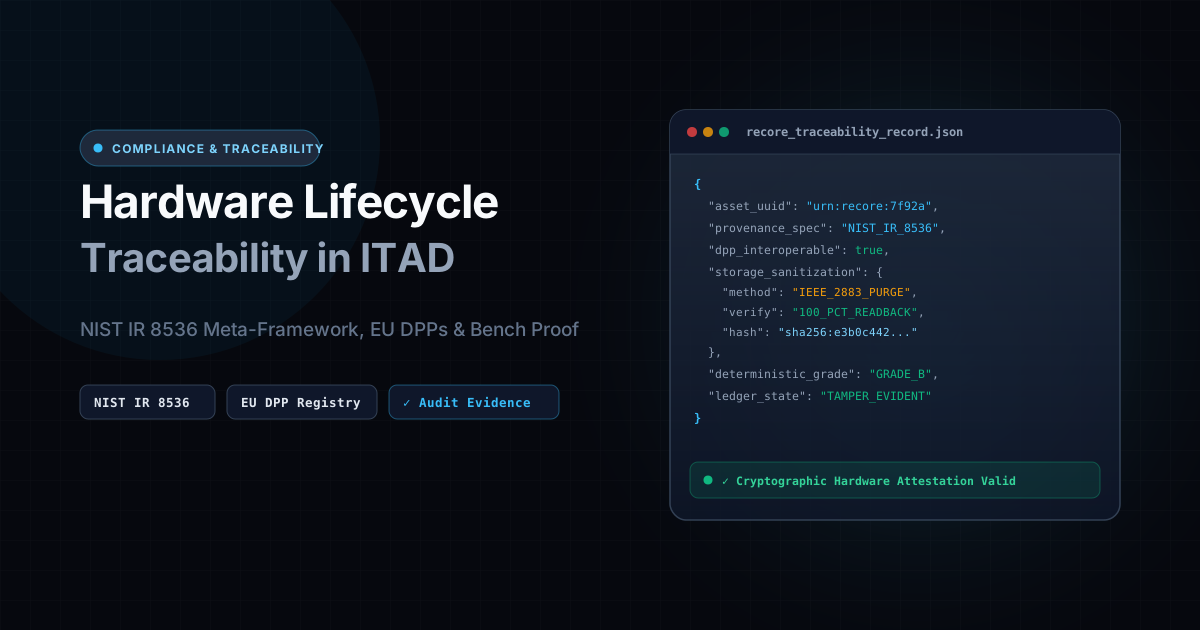
How NIST IR 8536 and the EU Digital Product Passport Registry transform IT asset disposition from simple inventory tracking into verifiable hardware lifecycle traceability.
For years, IT asset disposition (ITAD) has largely focused on answering a straightforward operational question:
Where is this device going next?
Back to the customer? To a secondary wholesale reseller? To a refurbishment line? To parts recovery? Or to a scrap recycler?
That question remains essential for daily warehouse throughput. But enterprise asset management, corporate risk officers, and downstream secondary markets are becoming more demanding. Increasingly, auditors and buyers ask a more detailed question:
What happened to this device before it arrived here, and what verifiable evidence proves it?
Answering that requires establishing the device's hardware identity, physical intake condition, component-level diagnostic history, data sanitization status, repair interventions, and final disposition grading.
Two institutional milestones in 2026 highlight this shift:
- NIST finalized IR 8536 on September 9, 2026. Titled Supply Chain Traceability Principles: A Manufacturing Meta-Framework, it establishes an industry-neutral model for securely exchanging, verifying, and validating pedigree and provenance across complex supply chains.
- The European Commission launched the Digital Product Passport (DPP) Registry on July 20, 2026. This created the core operational infrastructure under the Ecodesign for Sustainable Products Regulation (ESPR) to register unique identifiers and make structured product data accessible via standard interfaces.
Neither NIST IR 8536 nor the EU DPP Registry is an immediate "ITAD regulation." They do not mandate instant audit changes for refurbishment facilities today. However, they establish the technical and regulatory architecture for a major long-term transition: Hardware lifecycle data is shifting from an internal warehouse note into an essential, verifiable property of the physical asset itself.
The Core Problem: Fragmented Lifecycle Records
The physical lifecycle of an enterprise IT asset is continuous, but its digital record is historically fractured across organizational boundaries.
| Lifecycle Model | Data Storage Architecture | Downstream Asset Visibility |
|---|---|---|
| Traditional Fragmented Model | Disconnected silos across OEM build ERPs, enterprise ITAM databases, internal ITAD warehouse software, and local technician spreadsheets. | Basic invoice line item with a static, subjective condition flag (Grade B). Zero technical evidence travels with the hardware. |
| Integrated Traceability Model | Unbroken, event-driven ledger keyed to permanent hardware identifiers (Motherboard UUID, Baseboard Serial, Storage Serials). | Cryptographically verifiable record of intake damage, raw diagnostic metrics, sanitization hash, replaced part IDs, and validation results. |
When an asset moves between organizations, the underlying technical evidence rarely follows it:
- The OEM stores component build records and original bills of materials.
- The enterprise customer tracks assigned users and basic depreciated book value in an ITAM database.
- The ITAD operator records basic intake and functional test outcomes in an isolated warehouse management system (WMS).
- A specialized repair bench logs component replacements in a local spreadsheet.
- The downstream buyer receives only an invoice and a broad condition label like "Grade B."
This fragmentation destroys commercial value and introduces compliance risk. Two servers sitting side by side in an ITAD facility may share the same chassis, CPU family, and external appearance:
- Server A has an unverified storage history, undocumented intermittent DIMM errors, and no baseline diagnostic logs.
- Server B carries a tamper-evident audit record showing verified storage erasure, complete per-core stress test logs, verified power supply health, and documented firmware revisions.
The physical hardware is nearly identical. The verifiable asset value is completely different.
NIST IR 8536: A Meta-Framework for Hardware Provenance
Published by the National Institute of Standards and Technology on September 9, 2026, NIST IR 8536 (Supply Chain Traceability Principles: A Manufacturing Meta-Framework) provides a structured approach for cross-organization data exchange.
NIST emphasizes that modern traceability requires connecting data across disparate, sector-specific silos without forcing every participant into a single proprietary software platform.
| Focus Area | Core Principle in NIST IR 8536 | Practical Relevance to Secondary Hardware |
|---|---|---|
| Identity & Provenance | Unique cryptographic identities and hardware roots of trust. | Verifying that an intake asset matches its internal board-level serial numbers. |
| Attestation & Evidence | Machine-verifiable claims regarding state and compliance. | Providing cryptographically verifiable data erasure and diagnostic certificates. |
| Interoperable Trust Models | Open data exchange protocols across multi-tier supply chains. | Enabling ITAD processing records to integrate with enterprise ITAM and OEM registries. |
| Lifecycle-Aware Access | Role-based permissions across different lifecycle stages. | Allowing refurbishers to view component specs while protecting proprietary OEM data. |
| Emerging Architectures | Specific considerations for chiplets, AI accelerators, and modular hardware. | Tracking GPU health, memory degradation, and modular accelerator swaps. |
NIST IR 8536 is designed to be industry-neutral. It does not dictate specific warehouse workflows or create an ITAD certification. Its relevance to refurbishers is analytical: it defines how enterprise clients, defense contractors, and hyperscalers will structure hardware attestation requirements.
Digital Product Passports: Moving from Concept to Infrastructure
In the European Union, the Ecodesign for Sustainable Products Regulation (ESPR) is constructing the regulatory framework for product circularity. The technical backbone of this framework is the Digital Product Passport (DPP).
On July 20, 2026, the European Commission launched the DPP Registry, accompanied by testing environments and six harmonised technical standards. These standards establish protocols for unique identifiers, registry interfaces, data carriers (such as 2D data matrix barcodes and RFID), data exchange protocols, and storage security.
The European Commission’s implementation guidance explicitly includes repairers, refurbishers, and recyclers as designated stakeholders within the DPP data model.
| DPP Data Access Tier | Designated Stakeholders | Core Technical Data Exposed |
|---|---|---|
| Public Layer | Consumers, Enterprise Procurement Officers | General product specifications, energy efficiency ratings, recycled content percentages, basic warranty scopes. |
| Refurbisher & Repairer Layer | ITAD Technicians, Independent Refurbishers | Component-level disassembly schematics, compatible spare part SKUs, diagnostic fault code definitions, board test points. |
| Recycler & Smelter Layer | Certified Material Recyclers | Total component material weights, critical raw metal concentrations (cobalt, gold, neodymium, lithium), hazardous substance declarations. |
What DPP Data Refurbishers and ITADs Can Access
Under the EU framework, access to DPP data is tiered based on legitimate interest and authorization:
- Component-Level Disassembly Instructions: Direct schematics for opening enclosures without damaging modular sub-assemblies.
- Spare Part Compatibility Lists: Verified part numbers for OEM-compatible replacement batteries, screens, power delivery circuits, and cooling modules.
- Diagnostic and Error Code Maps: Machine-readable definitions of proprietary motherboard error codes, thermal sensors, and battery degradation curves.
- Substances of Concern and Critical Raw Materials: Exact declarations of battery chemistry, flame retardants, and precious metal concentrations for end-of-life recycling triage.
Under the current ESPR working plan, the indicative implementation timeline for Information and Communications Technology (ICT) products is set for approximately 2029. ITAD operators do not face an immediate compliance deadline today, but the architectural pattern is already established: hardware platforms will be expected to support structured lifecycle documentation.
Asset Tracking vs. Lifecycle Traceability
Many facilities confuse inventory tracking with lifecycle traceability. While warehouse management systems excel at physical location tracking, they rarely maintain the technical depth required for lifecycle traceability.
| Operational Dimension | Basic Warehouse Asset Tracking | Event-Driven Lifecycle Traceability |
|---|---|---|
| Core Question | Where is the asset located right now? | What is the complete, verifiable history of this asset? |
| Primary Data Key | Warehouse Location / Pallet ID / Internal Barcode | Cryptographic Board Serial / UUID / Component IDs |
| Diagnostic Record | Binary flag (PASS / FAIL) | Granular telemetry (SMART logs, cell voltage, port outputs) |
| Sanitization Record | Text note (Storage Wiped) | Tamper-evident certificate with algorithm, sectors, and drive hash |
| Repair Documentation | Generic labor charge code (1.5 hr rework) | Exact part replacement record with donor/new serial numbers |
| Grading Model | Subjective technician opinion (Grade B) | Deterministic grade derived from measurable diagnostic tolerances |
| Post-Processing Utility | Internal inventory reconciliation | High-trust resale documentation, ESG metrics, audit defense |
The 8-Stage ITAD Lifecycle Data Model
To bridge the gap between incoming hardware and structured traceability, ITAD and refurbishment facilities can structure their bench operations around eight core lifecycle events:
Data Sanitization as a Critical Traceability Anchor
Data destruction is both a security control and a legal milestone in the chain of custody.
Under NIST SP 800-88 Revision 2 (published September 26, 2025), media sanitization governance emphasizes establishing formal organizational sanitization programs, deferring media-specific clearing and purging execution to standards such as IEEE 2883-2022 and NSA specifications.
| Sanitization Audit Field | Example Recorded Parameter | Operational Verification Impact |
|---|---|---|
| Media Identification | Micron 7450 Enterprise NVMe (SN: 2348E6B18A42, Firmware: E200) | Proves sanitization was executed on the exact drive media, not merely the parent chassis. |
| Sanitization Command Set | NVMe Cryptographic Erase + User Data Overwrite (Purge) | Satisfies NIST SP 800-88 Rev. 2 Purge requirements and IEEE 2883-2022 command protocols. |
| Addressable Sector Range | LBA 0 through Max LBA (1,953,525,168 sectors) | Confirms complete media scope without bypassing over-provisioned or remapped pools. |
| Read-Back Verification | 100% Full Verification Read-back (Pattern: 0x00) | Proves zero readable residual customer data blocks across the physical address space. |
| Cryptographic Attestation | SHA-256 Hash + RSA Digital Signature (Station-04, Tech-8812) | Produces an immutable, tamper-evident record verifiable by third-party compliance auditors. |
When sanitization records are permanently attached to the asset profile, subsequent downstream owners can verify storage sanitization without needing direct access to the processing facility's internal database.
Commercial and Circular Economics of Traceability
The broader economic context reinforces the need for structured data. According to the Global E-waste Monitor 2024 (UNITAR/ITU), global e-waste generation reached 62 billion kilograms in 2022, while documented formal collection and recycling reached only 13.8 billion kilograms (22.3%).
Closing this gap requires keeping functional devices and components in secondary use longer. In secondary markets, information asymmetry directly depresses asset recovery value:
| Market Valuation Dimension | Asset Without Traceability (High Uncertainty) | Asset With Verifiable Traceability (High Trust) |
|---|---|---|
| Subsystem Health | Unknown residual wear, unverified battery capacity. | Documented 94% battery capacity, zero SMART reallocated sectors. |
| Component History | Unverified internal part swaps, possible grey-market parts. | Documented OEM original assembly or validated replacement SKUs. |
| Data Sanitization | Generic invoice line item ("Drives wiped"). | Cryptographic sanitization certificate tied to exact drive serial. |
| Buyer Risk Profile | High (buyer discounts bid to price in expected defect rates). | Low (proven operational state reduces warranty reserves). |
| Commercial Outcome | Wholesale discount penalty (-25% to -40%) | Defensible premium price realization + lower RMA return rates |
When an ITAD operator provides an auditable, machine-readable history, secondary buyers face less risk regarding hidden faults, unauthorized replacement parts, or incomplete data wiping. This operational transparency reduces return rates, lowers warranty reserves, and speeds up wholesale transactions.
Where reCore Fits Into the Traceability Workflow
This is where reCore by ReplugIT fits into the operational side of the hardware lifecycle.
reCore is designed to capture structured evidence from the device-processing workflow, connecting diagnostics, sanitization, grading, and reporting around the physical asset being processed.
Automated Diagnostic Telemetry
reCore can capture structured diagnostic results from supported bare-metal processing environments, including hardware information and test results covering areas such as CPU, memory, storage, battery, display, and device interfaces.
The important distinction is between a simple PASS result and the underlying evidence that produced it.
Instead of reducing a device to:
Diagnostic: PASS
a structured diagnostic record can retain the individual test results and measurements that support the final assessment.
Standards-Aligned Data Sanitization
reCore supports automated media-sanitization workflows aligned with applicable requirements and techniques, including workflows based on NIST SP 800-88 Rev. 2 and IEEE 2883-2022, where the selected sanitization method is appropriate for the media and organizational requirements.
NIST SP 800-88 Rev. 2 provides guidance for establishing a media-sanitization program and selecting appropriate techniques and controls. It does not prescribe one universal sanitization method for every storage technology. IEEE 2883-2022 specifies methods for sanitizing logical and physical storage and provides technology-specific requirements and guidance.
reCore records the sanitization operation and its result as part of the device-processing record, allowing the sanitization evidence to remain associated with the asset and its identified storage media.
Deterministic Grading
reCore can use configurable grading rules to turn diagnostic findings and defined condition criteria into repeatable grading outcomes.
The goal is not to claim that every grading decision can be reduced to one universal formula. Different ITAD operations have different customer requirements, cosmetic standards, resale channels, and commercial thresholds.
The advantage of a rules-based approach is that the criteria can be defined explicitly instead of relying entirely on individual technician judgment. That makes the resulting grade easier to reproduce, review, and explain.
Evidence and Audit Records
reCore can associate device identifiers, storage identifiers, diagnostic results, sanitization outcomes, grading information, and technician actions within an exportable processing record.
Where cryptographic integrity mechanisms are applied, hashes or digital signatures can be used to help demonstrate whether recorded information has been altered after it was generated.
This distinction matters:
- A hash provides an integrity check.
- A digital signature additionally provides cryptographic evidence tied to a signing key.
The specific mechanism used should therefore be described accurately rather than using "cryptographically signed" as a generic catch-all term.
What reCore Does Not Claim
reCore does not claim to replace an organization's broader compliance program, contractual obligations, applicable certifications, or legal responsibilities.
It also does not claim to be an official government Digital Product Passport gateway.
Instead, its role is practical: capture structured technical evidence at the point where the physical asset is actually being tested, sanitized, graded, and processed.
That distinction becomes increasingly important as hardware traceability evolves. NIST's newly finalized IR 8536 describes a technology-neutral approach for organizing, linking, and querying traceability information and discusses cryptographically verifiable links that can establish a secure timeline of product provenance. It is not an ITAD standard, but its principles are directly relevant to the broader question of how technical lifecycle evidence can remain connected across fragmented systems.
Practical Action Plan for ITAD Facilities
ITAD and refurbishment operators do not need to wait for a future Digital Product Passport requirement to improve the quality of their lifecycle data.
There are practical steps that can be implemented today.
1. Standardize Hardware Identifiers
Bind processing records to stable device identifiers wherever available and appropriate. Depending on the hardware and operating environment, this can include identifiers such as:
- Chassis or system serial number
- Baseboard or motherboard serial number
- System UUID
- Storage-device serial number
- Asset tag
Do not assume that every identifier is available, unique, immutable, or trustworthy on every platform. The objective is to create a consistent identity strategy that allows diagnostic, sanitization, repair, grading, and disposition records to remain associated with the same physical asset.
2. Preserve Diagnostic Evidence
Avoid reducing an entire diagnostic run to a single PASS or FAIL value. Where the diagnostic system produces meaningful measurements or error information, retain the underlying results. Depending on the hardware and test suite, that may include:
- Memory test results
- Storage health information and test logs
- Battery measurements (cycle count, full charge capacity, cell delta)
- Display results and pixel defect logs
- Port and interface loopback results
- Network interface tests
- Thermal curves and throttling measurements
- Hardware error codes and component-level findings
Not every device will expose every metric. The principle is simple: Keep the evidence that explains the conclusion.
3. Link Component Rework to the Asset Record
When a component is replaced during refurbishment, record the intervention against the asset whenever the required information is available.
For example:
- Asset: Laptop-12345
- Failure: Battery below defined threshold (62% health)
- Action: Battery replaced
- Replacement: OEM-compatible battery SKU / Serial
BAT-99420 - Technician: Technician ID
Tech-8812 - Post-repair test: Passed (Battery health 100%, charge curve normal)
Where component serial numbers are available and operationally useful, they can also be retained. This creates a clear operational relationship between Failure → Repair → Replacement → Validation rather than simply recording: "Repaired."
4. Attach Sanitization Evidence to the Storage Record
A sanitization certificate should be traceable to the storage media that was actually processed. A useful record can include, where applicable:
- Asset identifier
- Storage-device identifier (Serial, Model, Firmware)
- Media type (NVMe, SATA SSD, SAS HDD)
- Sanitization method (Cryptographic Erase, Block Erase, Overwrite)
- Sanitization result
- Processing timestamp
- Operator or technician ID
- Relevant tool and version information
- Certificate or evidence identifier
The exact fields should depend on the organization's sanitization policy and applicable requirements. NIST SP 800-88 Rev. 2 emphasizes establishing an organizational media-sanitization program and selecting appropriate sanitization techniques and controls based on the situation. IEEE 2883-2022 provides methods and technology-specific requirements and guidance for sanitizing logical and physical storage.
5. Prepare for Structured Data Exchange
Do not allow the only copy of an asset's lifecycle history to exist as a static PDF. PDF reports remain useful for human review, but machine-readable data is essential for automated systems.
Where practical, ITAD platforms should support structured exports or APIs containing asset and processing information. Depending on the organization's architecture, that may include formats such as:
- JSON
- CSV
- API responses
- Structured database exports
The objective is interoperability. A lifecycle record should be capable of moving between systems without requiring someone to manually retype the information.
This is particularly relevant to the broader direction of Digital Product Passports. The European Commission's DPP Registry includes infrastructure for unique product identifiers and associated metadata, while the DPP ecosystem is being developed around interoperability, data carriers, APIs, data exchange, and data storage.
6. Think in Lifecycle Events, Not Just Current Status
A traditional asset record might say:
Grade B
Ready for Sale
A traceable lifecycle record can tell a much more useful story:
Received → Diagnosed → Failed battery test → Repaired → Retested → Sanitized → Graded B → Remarketed
The second record preserves history rather than only the current state. That distinction becomes increasingly important as devices move through more repair, reuse, refurbishment, and recycling stages.
A Practical Traceability Workflow
A modern, traceable ITAD operational workflow connects every bench intervention back to the core asset identifier:
| Stage | Process Phase | Operational Action & Technical Evidence Captured |
|---|---|---|
| 01 | Intake & Receiving | Record client chain of custody, inbound lot ID, physical casing damage, missing sub-assemblies, and initial intake timestamp. |
| 02 | Hardware Identification | Interrogate hardware roots of trust via bare-metal boot (Chassis Serial, Motherboard UUID, MAC addresses, Storage Serials). |
| 03 | Automated Diagnostics | Execute diagnostic test suite; capture raw telemetry, memory test passes, battery degradation curves, and error codes. |
| 04 | Triage & Routing | Direct functional units to sanitization; route units with failed modular parts to repair; route non-viable units to parts harvesting. |
| 05 | Rework & Re-test | Execute component replacement; log donor/new part serials; run post-repair stress tests to confirm resolution. |
| 06 | Media Sanitization | Execute NIST SP 800-88 Rev. 2 / IEEE 2883-2022 Purge or Clear commands; generate cryptographic verification records. |
| 07 | Deterministic Grading | Evaluate cosmetic inspection metrics alongside diagnostic sensor data to calculate explainable, repeatable grades. |
| 08 | Disposition & Export | Bind all preceding event records into an exportable, tamper-evident audit ledger for enterprise clients or secondary buyers. |
The key operational principle is the unbroken evidence chain connecting each event to the same physical asset.
The Bigger Picture
Digital Product Passports and NIST's new traceability work should not be interpreted as a requirement for every ITAD company to immediately adopt a particular technology.
The more useful lesson is about data architecture.
The European Commission explicitly identifies repairers, recyclers, and refurbishers as stakeholders that can benefit from Digital Product Passport information, including product identification, traceability, repair, maintenance, refurbishment, sorting, dismantling, and recycling information. The information available to each user can vary according to the product group, applicable legislation, and access rights.
NIST IR 8536 similarly focuses on organizing, linking, and querying traceability data and on establishing verifiable provenance across fragmented supply chains.
For ITAD operators, that creates a useful principle:
Do not just record where the asset is. Record what happened to it.
That is the foundation on which more advanced hardware traceability can be built.
Authoritative References
- National Institute of Standards and Technology (NIST)
Supply Chain Traceability Principles: A Manufacturing Meta-Framework (NIST IR 8536)
Published: September 9, 2026. - European Commission
Digital Product Passport Registry & Ecodesign for Sustainable Products Regulation (ESPR)
Registry Operational Launch: July 20, 2026. - National Institute of Standards and Technology (NIST)
Guidelines for Media Sanitization (NIST SP 800-88 Revision 2)
Published: September 26, 2025. - International Telecommunication Union (ITU) / UNITAR
Global E-waste Monitor 2024: Quantifying Global E-waste Flows and Circular Economy Opportunities
Published: March 2024. - IEEE Standards Association
IEEE Standard for Sanitizing Storage (IEEE Std 2883-2022)
Published: August 2022.
reCore Research Lab
OfficialCompliance & Security Group
Technical research group specializing in NIST SP 800-88, IEEE 2883, SERI R2v3 standards, and forensic data recovery testing.
Automate Testing & Evidence for R2v3 Operations
Deploy reCore across hundreds of devices simultaneously with zero-touch PXE or USB boot. Generate SHA-256 verified PDF erasure certificates with separation of duties enforcement.
Related Guides & Research
Continue exploring compliance standards, firmware sanitization, and hardware diagnostics.
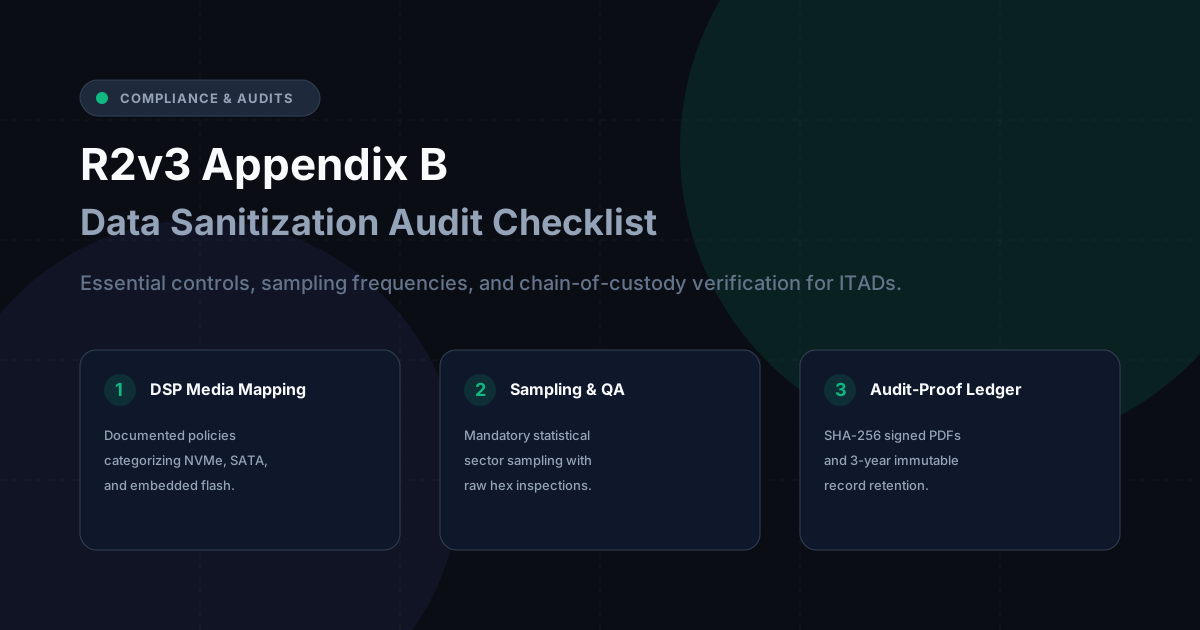
The R2v3 Appendix B Data Sanitization Audit Checklist for ITADs
Step-by-step R2v3 data sanitization audit process guide for ITADs. Master the 5% independent QA sampling rule, separation of duties, and software compliance.
The Death of Blanket Certificates: Why 2026 Regulations Demand Serial-Level Immutable Verification
Why corporate risk teams and R2v3 auditors reject bulk destruction receipts. Learn how cryptographic SHA-256 signatures and serial tracking ensure audit immunity.

DBAN for SSDs: Does It Actually Work? What to Use Instead in 2026
Can DBAN wipe an SSD? Learn why DBAN is designed for HDDs, how SSD and NVMe sanitization works, and what to use instead.
Stay Ahead in Data Sanitization & ITAD Compliance
Join enterprise IT managers and electronics refurbishers receiving our monthly technical standards breakdowns, NIST/R2v3 audit tips, and benchmark releases.