Your Grade A Could Be Someone Else's Grade B
No common grading scale exists for used laptops, and one floor can grade the same scratch two ways. Why grades drift, and how to make one mean one thing.

Your Grade A could be someone else's Grade B.
Anyone who sells refurbished laptops has lived this. A lot leaves your floor as Grade B. The buyer opens a few boxes, calls half of them C, and asks for a credit. Nobody lied. You just meant different things by "B".
That's two problems, not one. There's no shared definition of a grade between companies. And inside one company, people apply the definition they do have differently.
- There's no common grading scale for used Windows laptops or Macs. Phones have one; laptops don't.
- Even with a written standard, people judge the same scratch differently. Trained inspectors do too.
- The fix is a standard that's written per part and per defect, asked the same way at every station, and sent to the buyer with the grades.
1. There's no common scale for laptops
The phone market tried to solve this years ago. CTIA, the US wireless industry association, published grading scales for pre-owned wireless devices in 2019 and has revised them since. In May 2024 it aligned them with SERI's R2 Equipment Categorization. On June 10, 2026 it released Version 5.1, which adds guidance for "mapping wholesale market device condition grading criteria into direct-to-consumer relatable terms", plus requirements for battery health and genuine-parts declarations. CTIA says the scales let buyers and sellers "utilize a common grading definition throughout the industry."
That covers smartphones and tablets, and CTIA also publishes criteria for Chromebooks. For the Windows laptops and Macs that fill most ITAD floors, nothing comparable is shared. Each buyer, marketplace and refurbisher writes its own.
And most of those definitions are written in words, not measurements. eBay's refurbished program, for example, defines its tiers like this:
| eBay condition | How eBay describes the wear |
|---|---|
| Excellent - Refurbished | "like-new condition" |
| Very Good - Refurbished | "minimal wear" |
| Good - Refurbished | "moderate wear" |
Those are reasonable descriptions for a shopper. But "minimal" and "moderate" can't be measured at a bench. One technician's minimal is another's moderate.
2. Even one floor grades the same scratch two ways
Suppose you do write your own standard. Grades still drift, because looking at a device and judging it is hard to do the same way twice.
The best evidence comes from outside ITAD. In a 2015 study published in Human Factors, Judi See of Sandia National Laboratories had 82 trained inspectors examine 140 precision parts for eight kinds of defect. They correctly rejected 85% of the defective parts. They also rejected 35% of the parts that were fine. These were trained professionals, and they still missed some defects and flagged good parts.
A laptop lid is easier than a machined part. But the lesson carries over: the looser the definition, the more room each person has to read it their own way. "Light scratches" leaves a lot of room. "No scratch longer than 2 cm on the lid" leaves much less.
3. What inconsistent grades cost
Inconsistent grading doesn't show up as one big failure. It leaks out in small ways:
- Credits and disputes. A buyer who regrades your lot down will ask for money back, or pay less next time.
- Re-grading. Someone opens the boxes and grades the lot again, which is labour you've already paid for once.
- Pricing you can't defend. If two benches would grade the same unit differently, your grade mix is partly noise.
- Trust. A buyer who's been burned grades every lot from you themselves, and prices in the risk.
None of this needs a new scale for the whole industry to fix. It needs your scale to be clear, and applied the same way every time.
4. How to make a grade mean one thing
Here's what consistent grading looks like, whatever tools you use:
- Write it per part. Lid, bezel, palm rest, keyboard, screen, base. A grade for "the device" hides where the wear is.
- Make each defect concrete. A scratch you can feel with a fingernail, a crack, a missing key, a dead pixel. Where you can, use a measurement.
- Give each defect a ceiling. "A cracked screen can't be better than C." The device's grade is then the worst part's grade, and nobody has to weigh it up in their head.
- Ask the same questions, in the same order, at every bench. If every technician answers the same questions, the grade comes from the answers, not the person.
- Let functional results limit the grade. A device with a failed keyboard test shouldn't leave as Grade A, however clean it looks.
- Keep one standard per buyer when buyers differ. If one client grades stricter, grade their lots against their standard, not yours with a note.
- Send the definition with the grades. A buyer who can read what your "B" means can check it, instead of guessing.
- Record who graded what. When a dispute comes, you want the grade, the person, the time and the standard it was graded against.
5. How reCore does it
We built reCore's grading around those eight points. Here's what it does today, checked against the code.
You write your standard once, in the dashboard. Under Grading & Standards, a standard lists the parts, the defects each part can have, and a grade ceiling for each defect, such as "Max B". If a part matters to you that isn't in the list, you add it and write its question. The grade itself is the worst part's grade.
Every station asks that standard's questions. At the bench, the station shows which standard it's grading against and walks the technician through each part. One key per answer. From the answers and the ceilings, it works out the suggested grade. Same answers, same suggested grade, on every station.
Tests set a limit. A failed test caps the grade: a failed display, keyboard or camera test, for example, caps it at the bottom of the scale. If a technician overrides the grade above what the tests allow, the station warns them.
Different clients, different standards. You can give a batch its own standard, or set a default standard for a client, so a stricter client's lots are graded against their rules automatically.
The buyer gets the definition. reCore's stock list, a spreadsheet you can send with a lot, includes each unit's grade, its recorded defects by part, battery health and sanitization status, and a Grade Guide sheet that gives each grade's meaning as your standard defines it.
There's a history. Every grade is saved as a new record with who graded it, when, and which standard it was graded against, and the device page shows the history.
- It doesn't grade from photos. There's no camera or AI defect detection; the technician answers the questions.
- It doesn't make people see a scratch the same way. It makes the same answers give the same grade. Telling a "light" scratch from a "deep" one is still a person's call, which is why concrete defect definitions matter.
- The technician has the final say. The station suggests the grade and warns on a risky override, but doesn't block it, and it doesn't record a reason for a station override.
- Grade names are fixed at A, B, C, D and For-Parts, and grading covers laptops, desktops, all-in-ones and servers, not phones.
Conclusion
Until laptops get a shared scale like phones have, every "Grade B" in this industry is somebody's own definition. That's fine, as long as it's written down, applied the same way at every bench, and handed to the buyer with the lot. The disputes don't come from grades being different. They come from nobody being able to say what a grade meant.
See how reCore handles grading, or how workflows let each line run only the steps it needs.
Sources
- CTIA, CTIA Publishes Wireless Device Grading Standard in Support of Greater Transparency for Pre-Owned Devices, June 10, 2026 (Version 5.1).
- CTIA Certification, Grading Scales (smartphone and tablet criteria V5.1; Chromebook criteria V1.0).
- CTIA Certification, CTIA Updates Wireless Device Grading Standard to Help Extend the Lifecycle of Pre-Owned Wireless Devices, May 9, 2024 (alignment with SERI's R2 Equipment Categorization).
- J. E. See, Visual Inspection Reliability for Precision Manufactured Parts, Human Factors 57(8), 1427-1442, 2015.
- eBay, Item condition ID values (refurbished condition definitions).
Frequently asked questions
Is there a standard grading scale for refurbished laptops?
Not one that the market shares. CTIA publishes grading scales for smartphones and tablets (Version 5.1, June 2026) and criteria for Chromebooks, but there is no common scale for Windows laptops or Macs. Buyers, marketplaces and refurbishers each define their own grades.
Why do two technicians grade the same device differently?
Because visual inspection is a judgement, and most grade definitions are written in words like 'minimal wear' rather than measurements. Even trained inspectors are inconsistent: in a 2015 study of 82 inspectors published in Human Factors, inspectors correctly rejected 85% of defective parts but also rejected 35% of acceptable ones.
What did CTIA change in Version 5.1 of its grading scales?
According to CTIA's June 10, 2026 announcement, Version 5.1 adds guidance for mapping wholesale condition grades into terms consumers can relate to, and covers cosmetic criteria, standardized functional testing, battery health requirements and genuine parts declarations. It applies to wireless devices, not laptops.
How do you make grading consistent across stations?
Write the standard down per part and per defect, give each defect the highest grade it allows, have every station ask the same questions in the same order, and work the grade out from the answers. Then send buyers the definition along with the grades, and keep a record of who graded what.
Does reCore grade devices automatically from photos?
No. reCore doesn't use cameras or AI to detect cosmetic defects. The technician answers the standard's questions at the station, and reCore works out the suggested grade from those answers and the standard's grade ceilings.
reCore Diagnostics Group
OfficialHardware Triage & Quality Assurance
Hardware engineers analyzing Apple Silicon, PC OEM firmware telemetry, battery degradation chemistry, and cosmetic defect standards.
Make your grade mean one thing
Write your grading standard once. Every station asks its questions and suggests the same grade for the same answers.
Related Guides & Research
Continue exploring compliance standards, firmware sanitization, and hardware diagnostics.
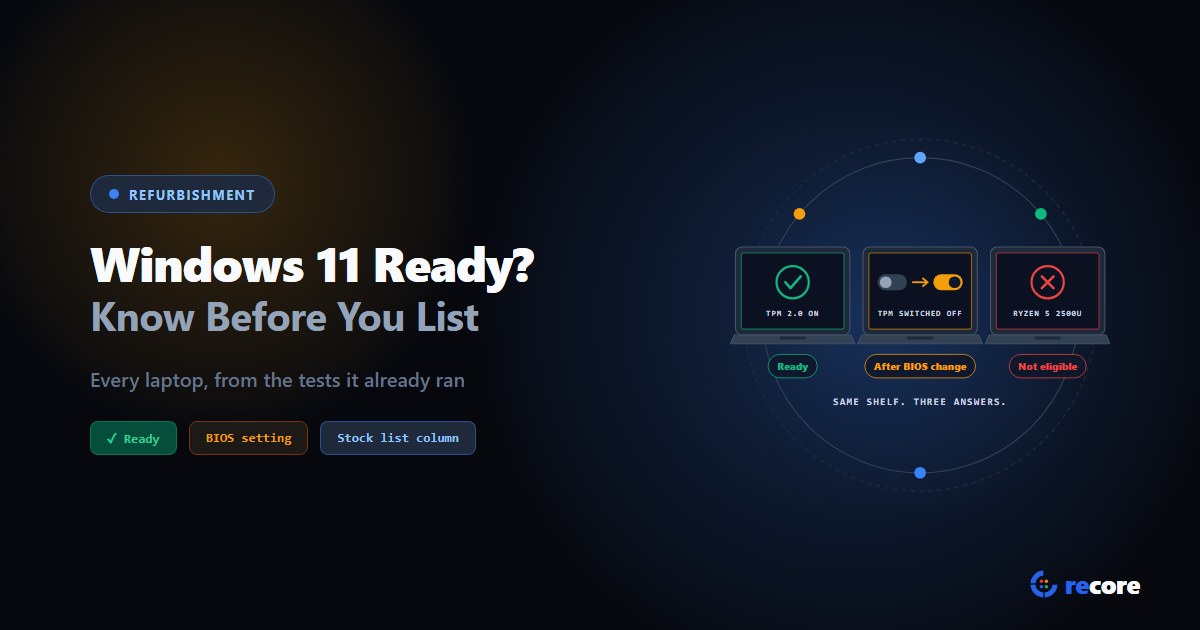
Windows 11 Ready? Check Every Refurbished Laptop Before You List It
How to tell which used laptops can run Windows 11, which need only a BIOS setting, and which can't, without installing Windows. Plus a free sample stock list.
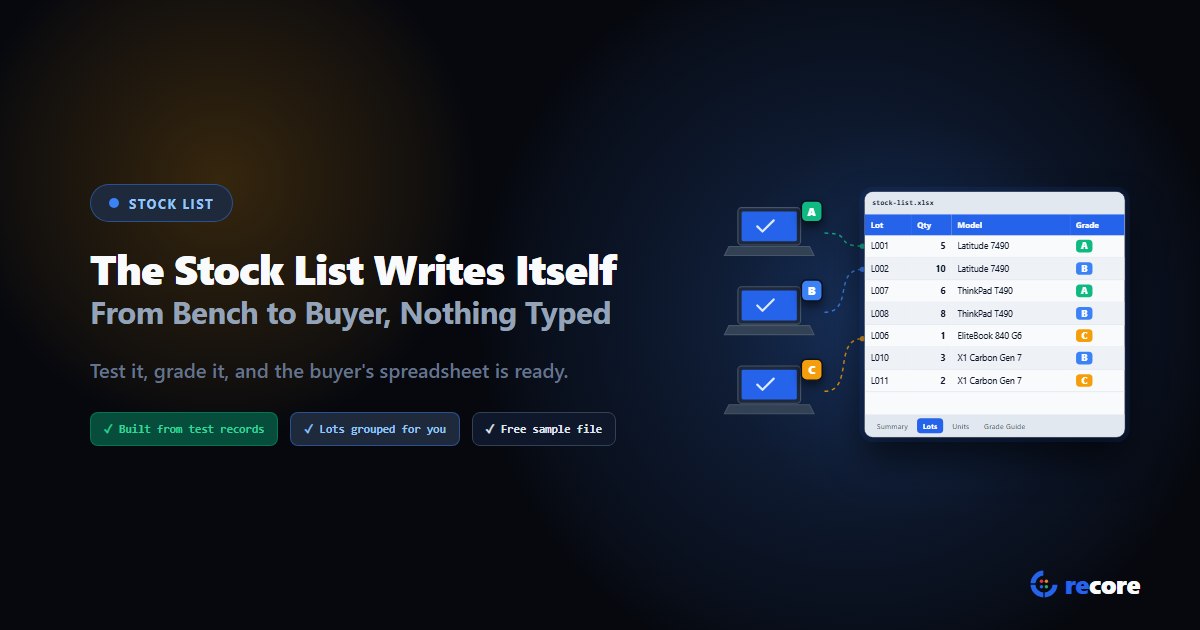
The Stock List Writes Itself: From Bench to Buyer Without a Spreadsheet
What a buyer needs on a refurbished laptop stock list, why hand-typed lists cost you credits, and how reCore builds one from test records. Free sample file.
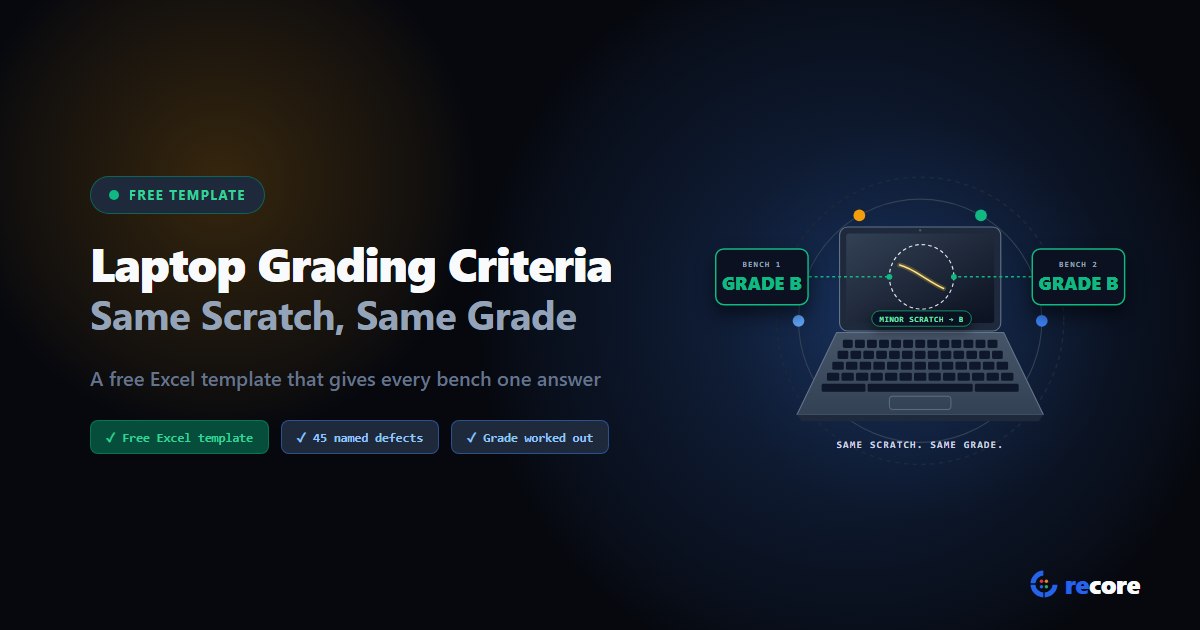
Laptop Grading Criteria: Same Scratch, Same Grade (Free Template)
Free laptop grading criteria template: 45 defects across 7 parts, the rules that turn them into A, B, C, D or For parts, and an Excel sheet that works out the grade.
Stay Ahead in Data Sanitization & ITAD Compliance
Join enterprise IT managers and electronics refurbishers receiving our monthly technical standards breakdowns, NIST/R2v3 audit tips, and benchmark releases.