Right to Repair in 2026: What Changes on a Laptop Refurbisher's Bench
The EU directive is law in some countries, Canada and Quebec have new rules, three US states restrict pairing on new units. What it means for refurbishers.
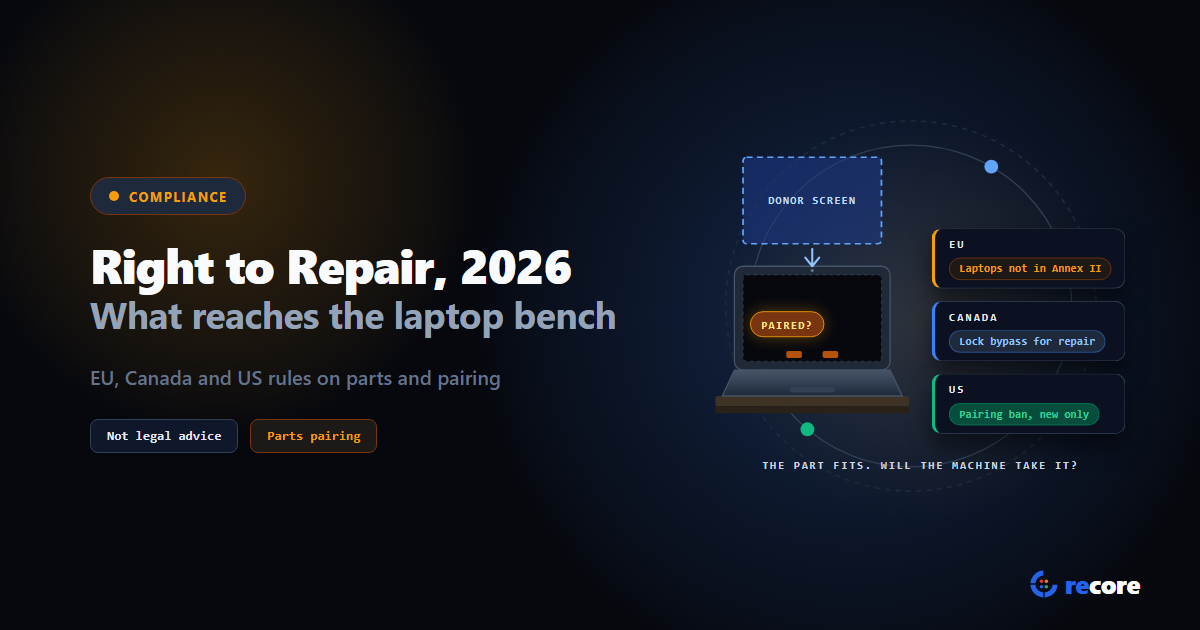
A donor screen works in one laptop and the next one refuses it. If you run a refurbishing bench, you've probably asked whether any law fixes that yet. In 2026, mostly not. Here is what the EU, Canada, Quebec and four US states actually changed.
EU member states had until 31 July 2026 to turn the Right to Repair Directive into national law. Some countries made it, Ireland among them. Its regulations came into effect on 31 July 2026. Many did not. On 25 September, Eunews reported that the European Commission had sent "a letter of formal notice to 18 countries, including Italy". Those countries now have two months to respond.
If you refurbish laptops, one finding matters more than the rest: the EU directive's core rules don't cover laptops at all.
We explain the laws here. It isn't legal advice.
- The EU directive makes makers repair, and bans them from blocking spare parts, only for the product groups in its Annex II. Laptops aren't on the list. Tablets and phones are.
- Canada's federal law lets you get around a digital lock to repair a product, but makers needn't sell you parts. Quebec puts duties on makers and on merchants, refurbishers who sell to consumers included.
- Oregon, Colorado and Washington restrict parts pairing, but only on newer devices: from 1 January 2025 in Oregon and 1 January 2026 in Colorado and Washington (exact wording in section 6). The laptops on most benches today are older.
- Most of these laws give rights to owners and repairers. The duties that reach a refurbisher come from selling to consumers.
1. Three terms first
An EU directive doesn't bind businesses on its own. Each member state has to pass a national law that puts it into effect, and that step is called transposition. Until a country does it, you usually have no national rule to follow there.
Parts pairing is when the maker's software links a part, such as a screen, battery or camera, to one specific device, usually by serial number. Fit a working donor part into another unit and the device may refuse it, cut features or show a warning. You know the problem: the part works, but this machine won't take it.
A TPM, or technological protection measure, is the Canadian Copyright Act's term for a digital lock: software or hardware that controls access to copyrighted code, such as firmware.
2. The EU directive, and why laptops aren't in it
Start with Article 5 of Directive (EU) 2024/1799, because the rest hangs off it. It says the manufacturer must repair, on the consumer's request, "goods for which, and to the extent that, repairability requirements are provided for by Union legal acts listed in Annex II."
Annex II lists ten product groups: household washing machines and washer-dryers, dishwashers, refrigerating appliances, electronic displays, welding equipment, vacuum cleaners, servers and data storage products, "mobile phones, cordless phones and slate tablets", tumble dryers, and goods with light means of transport batteries. A later Delegated Directive, (EU) 2026/74, adds an eleventh: domestic local space heaters. Laptops and desktop computers aren't on the list.
That hurts most with Article 5(6), the clause you'd think was written for refurbishers:
"Manufacturers shall, in particular, not impede the use of original or second-hand spare parts, compatible spare parts and spare parts issued from 3D-printing, by independent repairers..."
The same paragraph bans "contractual clauses, hardware or software techniques that impede the repair of goods covered by Union legal acts listed in Annex II", unless justified by "legitimate and objective factors including the protection of intellectual property rights." The spare-parts protection applies when the parts meet EU or national rules, such as product safety rules. So the EU does ban blocking second-hand parts. You just can't use that ban on a laptop. On tablets and phones, you can.
The list can grow. Article 5(9) has the Commission update Annex II by delegated act "at the latest 12 months after" a new EU repairability rule is published. Until laptops get one, they stay outside.
3. What in the EU directive does touch a refurbisher
Two parts of the directive do reach you, and neither depends on Annex II.
The first is a repair platform. Article 7 sets up a European online platform where consumers can find repairers and, "where applicable, sellers of refurbished goods". National platforms must be running by 31 July 2027. Each member state may extend its section to sellers of refurbished goods, and registration is voluntary. Ireland's will be built on repairmystuff.ie, ERP Ireland reports. So if you sell refurbished laptops in the EU, you may get a free listing, depending on your country.
The second is a longer guarantee after a repair. Article 16 amends the EU consumer sales directive: when a fault is fixed by repair as the remedy, "the liability period shall be extended once by 12 months." That covers sales contracts concluded from 31 July 2026. It isn't limited to Annex II, so if you sell laptops to EU consumers, it's a duty on you as the seller. Check how your own country handles second-hand goods, since the sales directive lets member states allow seller and consumer to agree a shorter liability period for them, as long as it's at least one year.
4. Canada: you may break the lock, but nobody has to hand you the key
Two federal bills received royal assent on 7 November 2024.
Bill C-244 (S.C. 2024, c. 26) adds section 41.121 to the Copyright Act. The ban on circumventing a TPM "does not apply to a person who circumvents a technological protection measure for the sole purpose of maintaining or repairing a product, including any related diagnosing". It also applies when you do it "for another person", so a shop repairing a client's unit is covered.
Bill C-294 (S.C. 2024, c. 27) rewrote section 41.12. You may now get around a lock for "making the program or a device in which it is embedded interoperable with any other computer program, device or component."
Here's the limit. Both bills only carve exceptions out of a prohibition. Neither makes a maker supply parts, manuals or tools. C-244 lifts only the ban on the act of circumventing, paragraph 41.1(1)(a). The separate bans on offering circumvention services or selling circumvention tools, paragraphs (b) and (c), still stand.
Interoperability is a little different. Section 41.12 also lets someone offer a service, or provide a tool, that gets around a lock, but only to make one computer program work with another. Whether fitting a donor part counts as interoperability is our reading to make, not a settled point.
On parts pairing, our reading is this: where a lock enforces the pairing, getting around it for a repair no longer breaches the Copyright Act. You still have to find a way to do it.
5. Quebec: duties on makers, and on you as a merchant
Quebec went further, and part of it lands on you. Bill 29 is the Act to protect consumers from planned obsolescence and to promote the durability, repairability and maintenance of goods. Three parts of it matter at the bench.
Since 5 October 2025, a warranty of availability has covered parts, repair services and repair information for goods "whose use may require the replacement, cleaning or updating of one of their components", BLG reports. The Consumer Protection Office's guidance lists a computer among its examples, and the warranty reaches the diagnostic software and updates needed for repair. It binds the manufacturer and any merchant that sells or leases goods to a consumer. The guidance also says it applies to used goods sold by a merchant in Quebec. That guidance isn't binding, and BLG notes it may go further than the law. Still, if you sell refurbished laptops to Quebec consumers, expect to tell buyers whether you guarantee parts, repair and repair information entirely, partially or not at all.
Section 227.0.3 bars makers and merchants from using "a technique that has the effect of making it more difficult for the consumer [...] to maintain or repair goods," Osler summarizes. There are two exceptions: safety, which doesn't apply when the repairer is a professional, and compliance with another law. The law doesn't name parts pairing. A pairing check that blocks a working part may fit the wording. That's our reading, and we found no case of the regulator or a court applying it that way yet.
The new good-working-order warranty started on 5 October 2026 and gives laptops three years. It covers only "specified categories of new goods", Osler notes, so it doesn't apply to the refurbished units you sell.
6. United States: three pairing bans, all for newer devices
Several states have electronics repair laws. We'll stick to the four that matter most if you work on laptops.
- New York. General Business Law 399-nn covers equipment first made, and first sold or used in the state, on or after 1 July 2023. Makers must give "any independent repair provider and owner" the documentation, parts and tools needed for repair "on fair and reasonable terms". A "tool" includes software that can "pair a part". It doesn't ban pairing. It makes makers provide the pairing tool. It excludes products sold under a specific "business-to-government or business-to-business contract" and not also offered directly by a retail seller. That may matter for ex-fleet laptops.
- Oregon. SB 1596 bans parts pairing on devices manufactured after 1 January 2025, Reinhart reports, with penalties starting in 2027. The source doesn't name laptops; we read them as covered.
- Colorado. HB24-1121 took effect on 1 January 2026. For equipment manufactured and sold or used in Colorado for the first time after that date, makers may not use pairing that "prevents an independent repair provider or owner from installing or enabling replacement parts". It also puts a duty on the repairer: before working, you must tell the owner you are "not an authorized repair provider" and whether you use new or used replacement parts from a supplier other than the maker.
- Washington. HB 1483, the Right to Repair Act, was signed on 19 May 2025, Dickinson Wright reports. It covers consumer electronics, Waste Dive says, "including laptops, cellphones and home appliances", and its parts pairing restriction applies after 1 January 2026, Waste Dive reports. The bill as introduced set the condition as products "manufactured for the first time, and first sold or used in this state" after a date, like Colorado's. It exempts some products, among them video game consoles, medical devices and motor vehicles. The legislature's site was unreachable when we checked, so we haven't read the enacted text; check it before relying on the exact date.
7. Side by side
| Jurisdiction | Law | In force | What it gives a refurbisher | Laptops covered? |
|---|---|---|---|---|
| EU | Directive (EU) 2024/1799 | 31 July 2026, country by country | Second-hand parts can't be blocked (Annex II goods); platform listing from 2027; 12-month guarantee extension when you repair | No for the parts rule; yes for the guarantee extension |
| Canada | Bills C-244, C-294 | 7 November 2024 | Getting around a digital lock for repair or interoperability isn't a copyright breach | Yes, but no right to parts or tools |
| Quebec | Bill 29 | 5 October 2025 | Makers and merchants must say what parts and repair information they guarantee; techniques that make repair harder are banned | Yes, computers are in the guidance; you have duties as a merchant |
| New York | GBL 399-nn | Equipment made and first sold from 1 July 2023 | Documentation, parts and tools, pairing software included | Yes, except B2B-only sales |
| Oregon | SB 1596 | 2025, penalties from 2027 | Parts pairing banned | Devices made after 1 January 2025 |
| Colorado | HB24-1121 | 1 January 2026 | Pairing that blocks your parts is banned | Equipment manufactured and sold or used in Colorado for the first time after 1 January 2026 |
| Washington | HB 1483 | Signed 19 May 2025; pairing rule from 1 January 2026 | Parts pairing restricted | Yes, as reported, for products first manufactured and first sold or used in Washington after 1 January 2026 |
8. What this means at the bench today
Take the donor screen your 2021 laptop won't accept. Today, these laws mostly don't reach it. The pairing bans start with devices made or sold in 2025 or 2026. The EU's parts rule skips laptops. Canada lets you get around the lock, but no maker has to give you the means.
So keep your own record of what went into which unit:
- Note the donor's serial number against every part you move.
- Test the receiving unit after the swap, not just before it.
- If a part is refused, record how: an error, lost features, or a warning. In Oregon, Colorado or Washington that record could matter for newer devices.
- If you sell to consumers in the EU or Quebec, review what you promise about repairs and parts.
9. Where reCore fits
Software can't change these laws, but it can prove a repaired unit works. reCore's station runs 17 automated tests and 6 guided checks, and the manual checks take under a minute per laptop. Run them before and after a part swap and you have a record of what worked each time. Grading follows the profile your organisation sets in the dashboard, so a unit with a donor part is graded on the same rules as the rest.
If you'd like to see that record on your own units, email [email protected].
For phones and tablets, part-level locks raise separate questions, which we covered in what ITAD should record about locked parts.
Conclusion
For laptop refurbishers, right to repair is arriving unevenly. The rules against blocking parts mostly skip laptops or reach only the newest ones. The duties that reach you come from selling to consumers: a longer guarantee after repair in the EU, parts disclosures in Quebec. Read your own jurisdiction's text, record every part you move, and watch whether Annex II adds laptops.
Sources
- Directive (EU) 2024/1799 on common rules promoting the repair of goods, EUR-Lex. Articles 5, 7, 16, 21, 22 and Annex II.
- Commission Delegated Directive (EU) 2026/74, EUR-Lex, adding domestic local space heaters to Annex II.
- Directive (EU) 2019/771 on the sale of goods, EUR-Lex, Article 10(6) on second-hand goods.
- Eunews, "Right to repair: Italy and 17 other countries have failed to transpose the directive, EU infringement proceedings begin", 25 September 2026.
- ERP Ireland, "Ireland Transposes the EU Right to Repair Directive", 19 August 2026.
- Parliament of Canada, Bill C-244, royal assent text and Bill C-294, royal assent text; Copyright Act, sections 41.1 to 41.121.
- Osler, "From purchase to repair: how Bill 29 reshapes consumer rights in Quebec", 30 July 2025, and "Rules are set: warranty of good working order", 1 April 2026.
- BLG, "Québec's warranty of availability: are companies ready for October 5?", 3 October 2025.
- New York State Senate, General Business Law section 399-nn.
- Reinhart, "Oregon Passes Right to Repair Law: First to Ban Parts Pairing", 23 April 2024.
- Colorado General Assembly, HB24-1121, Consumer Right to Repair Digital Electronic Equipment.
- Waste Dive, "Washington passes right-to-repair bills for electronics and wheelchairs", updated 21 May 2025.
- Dickinson Wright, "Washington State Joins Right-to-Repair Movement", 20 May 2025.
- Washington State Legislature, HB 1483, original bill text, via wa-law.org, section 3(1)(b).
Frequently asked questions
Does the EU Right to Repair Directive cover laptops?
No, not as of November 2026. The manufacturer's duty to repair and the ban on blocking spare parts apply only to the product groups listed in Annex II of Directive (EU) 2024/1799. Laptops aren't on that list. Mobile phones, cordless phones and slate tablets are, along with appliances, displays and servers. The Commission can add product groups later when new EU repairability rules are adopted.
Which law bans parts pairing on laptops?
Of the laws covered here, Oregon, Colorado and Washington restrict parts pairing on consumer electronic equipment. Waste Dive's report on Washington's law lists laptops among the products covered. The Oregon and Colorado sources we read don't name laptops, but they appear to fall within both (our reading). Oregon's rule applies to devices manufactured after 1 January 2025. Colorado's applies to equipment manufactured and sold or used in Colorado for the first time after 1 January 2026. Washington's, as reported, applies to products manufactured for the first time, and first sold or used in the state, after 1 January 2026. None of them reaches older machines. The EU rule against blocking parts covers Annex II goods only, and Canada's federal law lets you get around a digital lock for repair without banning the lock.
Do right to repair laws put obligations on refurbishers?
Mostly they give rights to owners and independent repairers. A few duties reach you as a seller. In the EU, if a consumer's fault is fixed by repair under the legal guarantee, the seller's liability period is extended once by 12 months. In Quebec, the parts availability warranty applies to merchants too, and the regulator's guidance says it covers used goods. Colorado requires independent repair providers to tell owners they are not an authorized repair provider.
Can I list my refurbished laptops on the EU repair platform?
Possibly, depending on your country. The directive sets up a European online platform for repair that lists repairers and, where applicable, sellers of refurbished goods. Each member state decides whether its section covers sellers of refurbished goods, and registration is voluntary. National platforms must be running by 31 July 2027. In Ireland, repairmystuff.ie will be the basis of the national platform.
Is parts pairing illegal in Canada?
There is no federal ban on parts pairing. Bill C-244 lets you, or a repairer working for you, get around a digital lock "for the sole purpose of maintaining or repairing a product, including any related diagnosing", but no maker has to give you the means. In Quebec, section 227.0.3 of the Consumer Protection Act bars techniques that make repair more difficult. In our reading it may cover a pairing check that blocks a working part, but we found no case of it being applied that way.
reCore Research Lab
OfficialCompliance & Security Group
Technical research group specializing in NIST SP 800-88, IEEE 2883, SERI R2v3 standards, and forensic data recovery testing.
Evidence your auditor will accept
A wipe record and verification for every drive, and certificates with second-person approval, ready for an R2v3 audit.
Related Guides & Research
Continue exploring compliance standards, firmware sanitization, and hardware diagnostics.
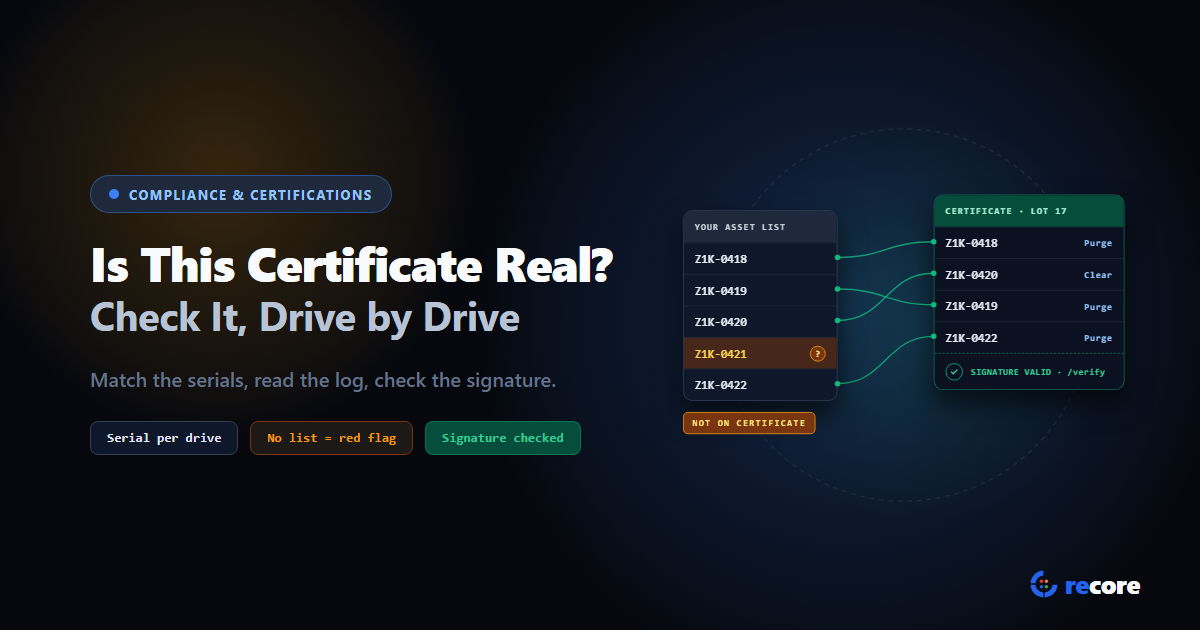
How to Check a Data Destruction Certificate Is Real
How to verify a certificate of data destruction for hard drives and SSDs: what it must show for each drive, the red flags, and four checks you can run.
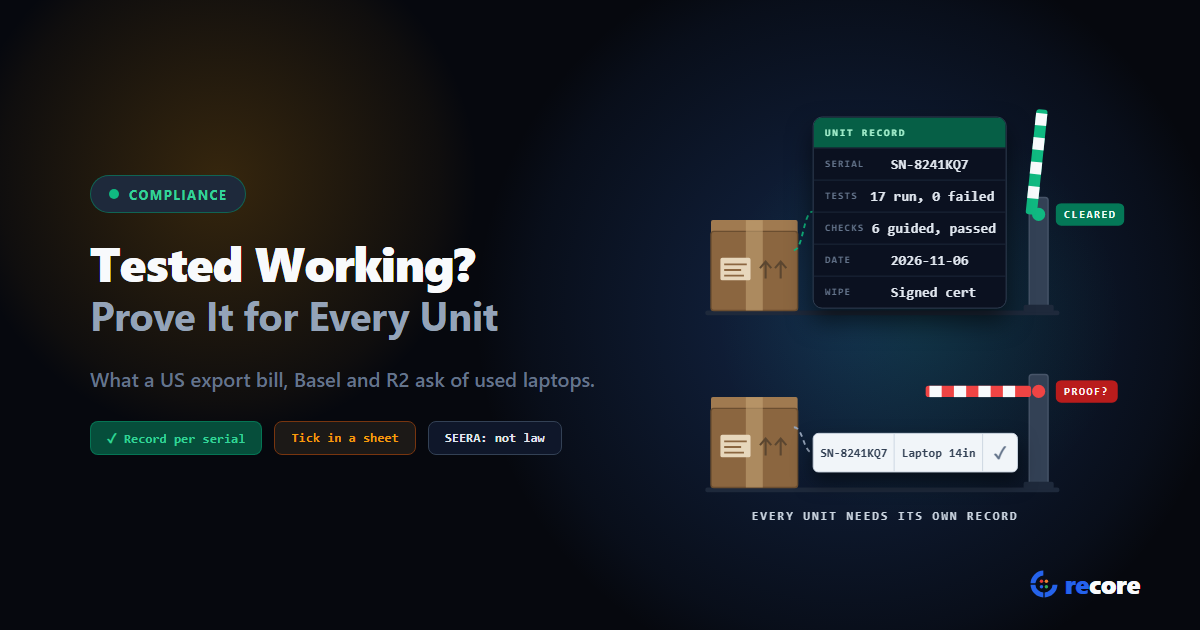
SEERA and Tested-Working Exports: The Record to Keep for Every Unit
A US bill would bar most used electronics exports unless tested and working. What it says, what Basel and R2 already ask, and the record to keep.
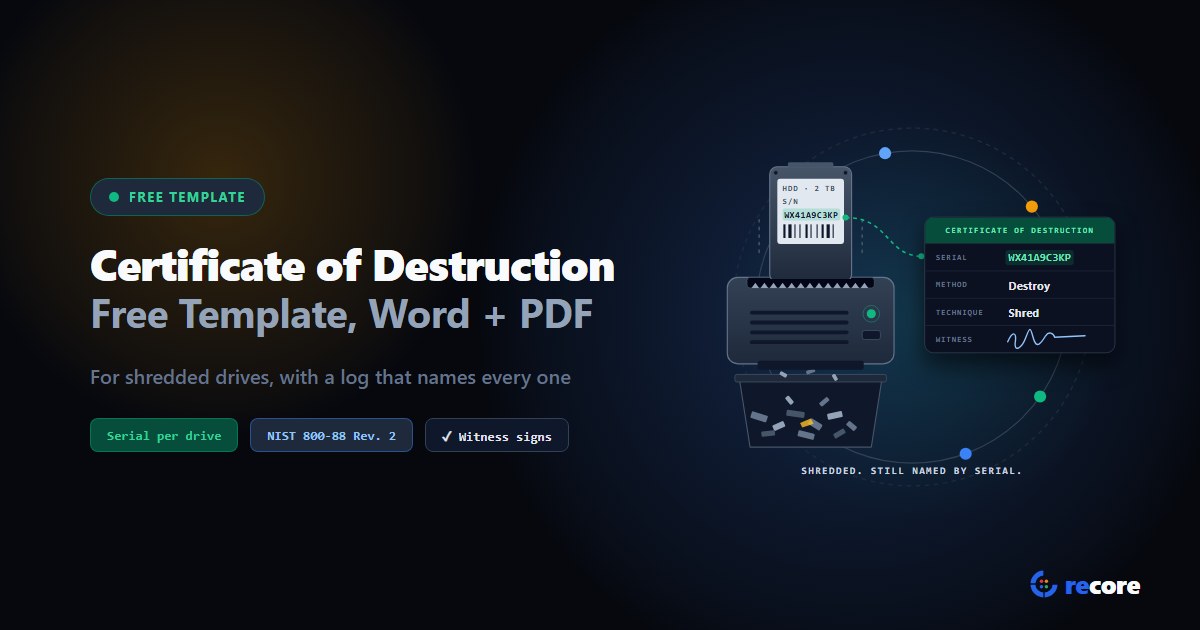
Certificate of Destruction Template for Hard Drives (Free, Word + PDF)
A free certificate of destruction template for hard drives and SSDs, in Word and PDF, with a per-drive log and the fields NIST SP 800-88 Rev. 2 lists.
Stay Ahead in Data Sanitization & ITAD Compliance
Join enterprise IT managers and electronics refurbishers receiving our monthly technical standards breakdowns, NIST/R2v3 audit tips, and benchmark releases.