SEERA and Tested-Working Exports: The Record to Keep for Every Unit
A US bill would bar most used electronics exports unless tested and working. What it says, what Basel and R2 already ask, and the record to keep.
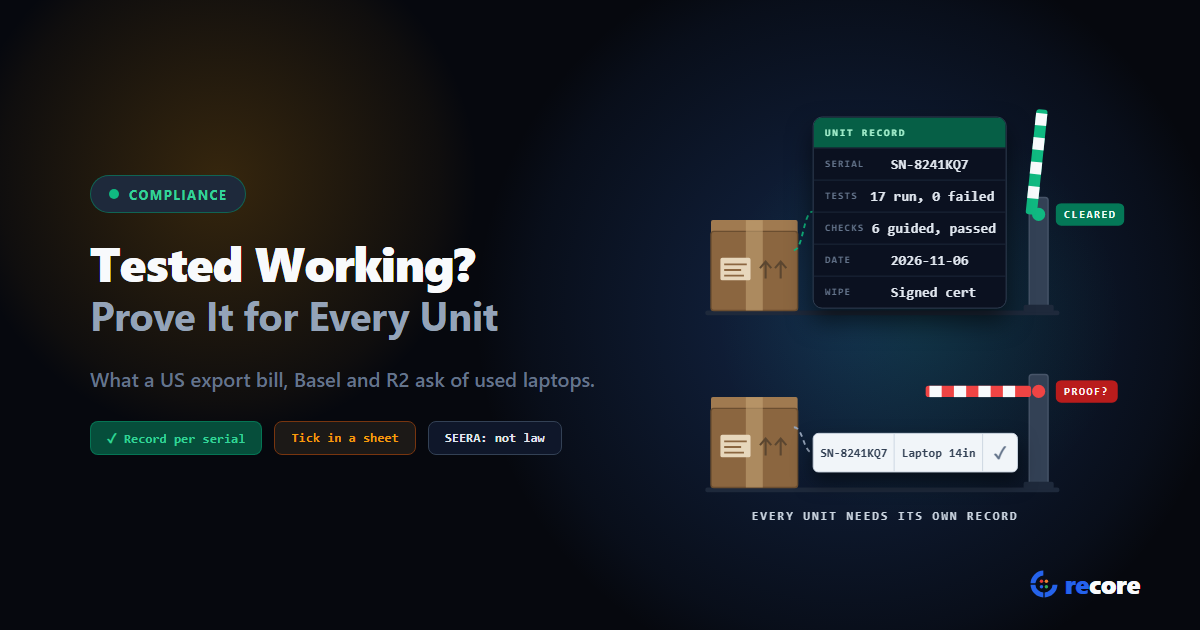
If you sell used laptops abroad, or sell to brokers who do, a bill in Congress would require proof that each one was tested and works, and a broker would ask you for it. It isn't law. On November 6, Resource Recycling ran an analysis called "Midterms put e-scrap legislation in focus," on what the November 3 elections could mean for e-scrap laws. (E-scrap is the trade's word for used electronics headed for recycling or reuse.) It says the Secure E-Waste Export and Recycling Act (SEERA) "could receive renewed attention," and that "the legislation seeks to restrict exports of certain electronic waste and encourage domestic processing."
The bill would ban the export of most used electronics on its list, laptops included, with a few exemptions. The one that matters to a refurbisher is for units that are tested and working. Nobody knows yet whether it will pass. What it asks you to prove is already clear, though, and R2 auditors and the Basel Convention's guidelines for enforcement agencies already ask for much of the same thing.
- SEERA (H.R. 2998) was introduced in April 2025. It hasn't passed, and earlier versions failed too.
- As written, the main way to export a used laptop for reuse would be the "tested, working" exemption, and the shipment would carry "test results for each item."
- The Basel Convention's e-waste guidelines already ask for test records "on every item within the shipment." If you or your buyer is R2 certified, a unit sold in R2's functioning categories F3 to F6 must already be tested and verified through R2's test and repair appendix.
- So the useful work is the same whatever Congress does: a test record per unit, tied to the serial, made by the machine that ran the tests.
1. What the news says
The Resource Recycling piece notes that SEERA was reintroduced in 2025 by a Republican and a Democrat, Reps. Mario Diaz-Balart and Adriano Espaillat, and that "[e]arlier versions repeatedly failed to become law." It also suggests one route for 2027: attaching SEERA to a broader defense or China-related competitiveness bill.
The article is also clear that the industry is split. "Domestic processors support retaining materials and processing activity in the United States, while international reuse and refurbishment businesses are concerned about restrictions affecting legitimate secondary markets and equipment recovery values."
We won't guess who wins. Either way, a floor that exports can make sure every unit it calls "tested working" has a record behind it.
2. What the bill actually says
The current version is H.R. 2998, introduced on April 24, 2025 by Rep. Espaillat with Rep. Diaz-Balart and referred to the House Committee on Foreign Affairs. That referral is the latest action listed. It hasn't passed either chamber.
It defines "electronic waste" widely. The list includes "computers and related equipment" and data center gear, and laptops and tablets are named. Then it bans exports outright: "no person or entity may export or reexport electronic waste or exempted electronic waste items," except as the bill allows.
The exemption that matters here is "tested, working used electronics." These are used items "determined, through testing methodologies established by the Secretary," to be "fully functional for the purpose for which the items were designed." For a multifunction device, it's enough to be "fully functional for at least one of the primary purposes for which the items were designed." The Secretary here means the Secretary of Commerce.
They must also be "exported with the intent to reuse the products as functional products" and "appropriately packaged for shipment to prevent the items from losing functionality as a result of damage during shipment."
The exporter would also have to be on a public registry kept by Commerce and file export information for each shipment. Each shipment would need to carry, among other things:
"a declaration signed by an officer or designated representative of the exporter asserting that the exempted electronic waste items meet the applicable requirements for exempted electronic waste items under this section"
and
"for tested, working electronics, a description of the testing methodologies and test results for each item"
It says for each item. A line on your packing list saying "50 laptops, tested working" wouldn't meet it.
The bill leaves one big thing open. Commerce has set no testing methods, because the bill isn't law, and the ban itself would only take effect a year after the bill became law. So nobody can tell you today exactly which tests would count. Commerce could also exempt personal shipments of 20 items or fewer, but that wouldn't cover a reseller's lot.
3. What the Basel guidelines and R2 already ask
The Basel Convention guidelines. The Basel Convention is the international treaty on moving hazardous waste across borders. In 2023 its parties adopted, on an interim basis, the current version of its technical guidelines on how to tell used equipment from e-waste (decision BC-16/5). It updates earlier interim versions from 2015 and 2019, and the passages we quote below read the same in the 2015 text. They're written for "government agencies, including enforcement agencies," and also to inform anyone arranging a shipment. That includes you, or the broker you sell to. These guidelines aren't law in the US, which signed the Basel Convention in 1990 but has never ratified it. But many countries your laptops land in are parties (191 in all), and the guidelines are written for their authorities.
Under paragraph 32, your used equipment headed for direct reuse should normally not be treated as waste when, among other things, the shipment has:
"Evidence of evaluation or testing in the form of a copy of records (certificate of testing – proof of functionality) on every item within the shipment"
A footnote adds: "Testing of used equipment should be performed before shipment in the country of export." Under paragraph 33, the papers that travel with that shipment should include a "Signed declaration that indicates that the equipment has been tested and is destined for direct reuse and fully functional." Paragraph 39 sets the bar for the test itself: "The completion of a visual inspection of the equipment without testing its functionality is unlikely to be sufficient. For most of equipment, a functionality test of key functions is sufficient." Paragraph 41 lists what the record should hold. We've built the table below from it.
R2. SERI, the body behind the R2 standard, says on its knowledge base that "products that are sold for reuse must meet the criteria of one of the Functioning Product Categories," and that categories F3 through F6 require "that the device be tested and verified functioning through Appendix C." It also says simple "power-on verifications, visual inspections and even some basic level testing" are evaluations, "not considered part of the functionality testing under Appendix C." In a second article, about parts and components, SERI says an R2 facility that tests and repairs components itself must pass functioning components to the buyer "by identifying and disclosing the appropriate REC (or equivalent) categories for functionality, data sanitization status and cosmetic condition." REC is SERI's R2 Equipment Categorization.
So the bill, the Basel guidelines and R2 point the same way: test each unit for real, record the result per unit, and pass it on. (For how R2 compares with other certifications, see our ITAD certifications comparison.) This article explains documents; it isn't legal advice. For what applies to your shipments, check with your counsel or certification body.
4. Why a tick in a spreadsheet isn't proof
A common way to keep "tested working" is a spreadsheet column: serial, model, a W or a tick. If that's you, the tick shows someone thought the unit worked. It doesn't show:
- Which tests ran. Did anyone test the battery, the keyboard, every port, the camera? A tick can't say.
- What each test found. A laptop with one dead port isn't fully functional, and the buyer should know. A tick hides it.
- When, and by whom. Basel's list asks for the date of the test and the company responsible for the result. A cell in your sheet shows neither.
- That the tick belongs to that serial. Hand-typed serials go wrong one character at a time, and then the tick sits on the wrong machine.
It's the same problem we wrote about for wipe records in why R2v3 auditors reject sanitization spreadsheets. A typed claim isn't evidence. The proof is a record made by the tool that ran the test, at the moment it ran.
5. What a tested-working record should hold
Here is a per-unit record built from what the three sources ask for. Basel numbers are paragraphs of the 2023 guidelines.
| Field | Why it's there | Who asks |
|---|---|---|
| Make, model, serial | The serial ties the record to one physical machine | Basel 41(a) to (c) ask for item, producer and type number; SEERA says "for each item" |
| Year of production, if known | Helps the buyer and officials judge age | Basel 41(d) |
| Tests that ran | Shows it was more than a power-on check | Basel 41(g) "Kind of tests performed"; SEERA "testing methodologies" |
| Result of each test, faults named | "Fully functional" or the exact defect | Basel 41(f); SEERA "test results for each item" |
| Date of the test | Proves testing happened before shipment | Basel 41(f) and footnote 9 |
| Company, station and technician | Who stands behind the result | Basel 41(e) (company); paragraph 40 (trained technician) |
| Signed declaration | Someone accountable confirms it | Basel 41(h); SEERA signed declaration |
| Data wipe status, per drive | The buyer needs to know the drives are clean | R2, via SERI's guidance on components: "data sanitization status" |
| Functional and cosmetic category | What the buyer is actually getting | R2, via SERI's guidance on components: REC categories |
Basel paragraph 42 also says the record should travel with the shipment, fixed to the unit or its packaging "so that it can be read without unpacking the equipment."
A quick check for this week: pull five units from your last export lot. For each, show the tests that ran, the results, the date and the wipe status from records alone, without asking the technician. Any unit that ends at a spreadsheet tick shows you the gap.
6. Where reCore fits
reCore covers the test and wipe rows of that table, per device, as part of its normal flow. On the station, 17 automated tests and 6 guided manual checks are saved to the device's record, with the hardware details read from the machine itself. Every drive gets its own wipe certificate. The wipe method follows NIST SP 800-88 Rev. 2, and each certificate is signed, so a buyer or auditor can check it at recore.replugit.com/verify without an account. The stock list and the shipping list are built from that device data, with no re-typing.
reCore doesn't make anyone compliant with SEERA, the Basel guidelines or R2. It keeps per-unit evidence of the kind those documents describe. If you'd like to see what those records look like, email [email protected].
Whatever Congress decides
SEERA may pass in 2027, change on the way, or fail again like the versions before it. The question it asks a floor that exports is already being asked by the Basel guidelines, by R2 auditors and by buyers: can you show, unit by unit, that this machine was tested and works? A tick in a spreadsheet can't answer that. A record made by the machine that ran the tests can, and you'll want it whatever Congress decides.
Sources
- David Daoud, "Midterms put e-scrap legislation in focus," Resource Recycling, November 6, 2026. All quotes and news in the introduction and section 1.
- U.S. Congress, H.R. 2998, Secure E-Waste Export and Recycling Act, 119th Congress, introduced April 24, 2025. Bill text as introduced, read on congress.gov; status from the Library of Congress bill status record on govinfo.gov.
- Basel Convention, Technical guidelines on transboundary movements of electrical and electronic waste and used electrical and electronic equipment, version of 9 March 2023, UNEP/CHW.16/INF/10, adopted on an interim basis in decision BC-16/5, 2023 (updating the interim versions of 2015, UNEP/CHW.12/5/Add.1/Rev.1, and 2019, decision BC-14/5). Paragraphs 5, 32, 33, 39 to 42 and footnote 9.
- United Nations Treaty Collection, Basel Convention, status of signatures and ratifications: 191 parties; the United States signed on 22 March 1990, with no ratification listed.
- SERI, "When evaluating for reuse, are Appendix C and QMS required?" and "Requirements for testing parts and components", R2 Guidance & Knowledge Base.
- NIST, SP 800-88 Rev. 2, Guidelines for Media Sanitization.
Frequently asked questions
Has the Secure E-Waste Export and Recycling Act passed?
No. The current version is H.R. 2998, introduced in the House on April 24, 2025 and referred to the Committee on Foreign Affairs. That referral is the latest action in the official bill status record. Resource Recycling wrote on November 6, 2026 that it could get renewed attention, possibly attached to broader legislation in 2027, and that earlier versions repeatedly failed to become law.
What does the bill mean by tested, working used electronics?
Used items found, through testing methods the Secretary of Commerce would set, to be fully functional for the purpose they were designed for (or, for multifunction devices, at least one primary purpose), exported for reuse, and packed so they don't break in transit. Commerce has set no such methods, because the bill is not law.
Is a power-on check enough to call a laptop tested working?
Not by the guidance that already exists. The Basel Convention's e-waste guidelines say a visual inspection without testing functionality is unlikely to be enough. SERI, which runs R2, says power-on checks and visual inspections count as evaluation, not as Appendix C functionality testing.
What should a per-unit test record include?
At least the make, model and serial, which tests ran, the result of each one including faults, the date, the company and station or technician that tested it, a signed declaration, and the data wipe status of each drive. The Basel guidelines list most of these fields in paragraph 41.
reCore Research Lab
OfficialCompliance & Security Group
Technical research group specializing in NIST SP 800-88, IEEE 2883, SERI R2v3 standards, and forensic data recovery testing.
Evidence your auditor will accept
A wipe record and verification for every drive, and certificates with second-person approval, ready for an R2v3 audit.
Related Guides & Research
Continue exploring compliance standards, firmware sanitization, and hardware diagnostics.
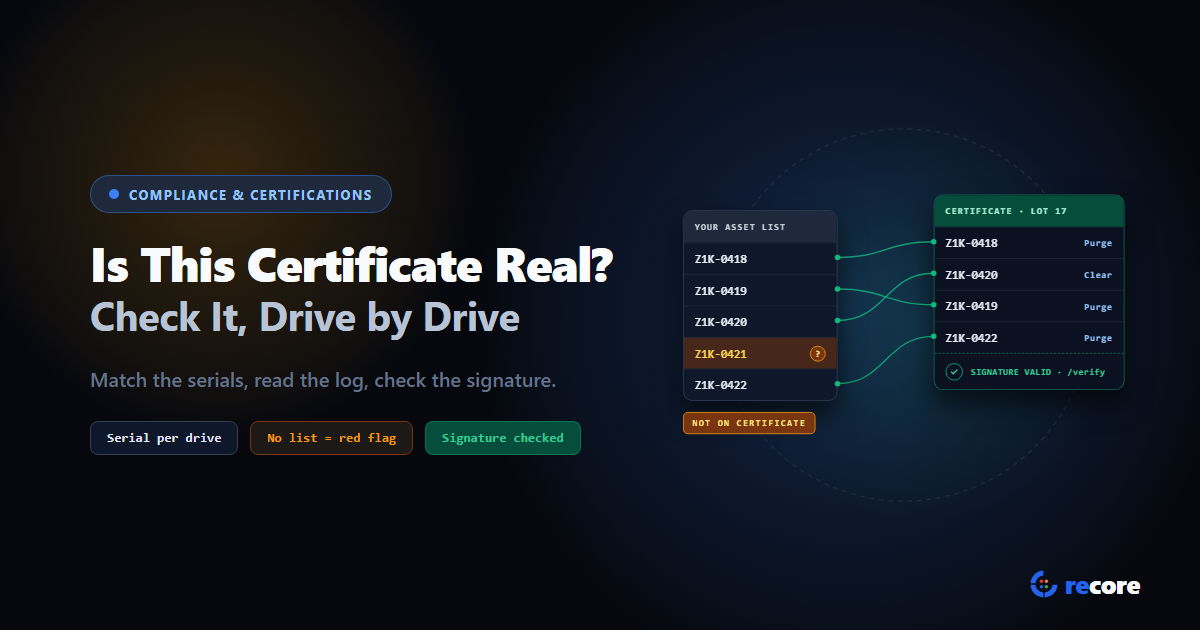
How to Check a Data Destruction Certificate Is Real
How to verify a certificate of data destruction for hard drives and SSDs: what it must show for each drive, the red flags, and four checks you can run.
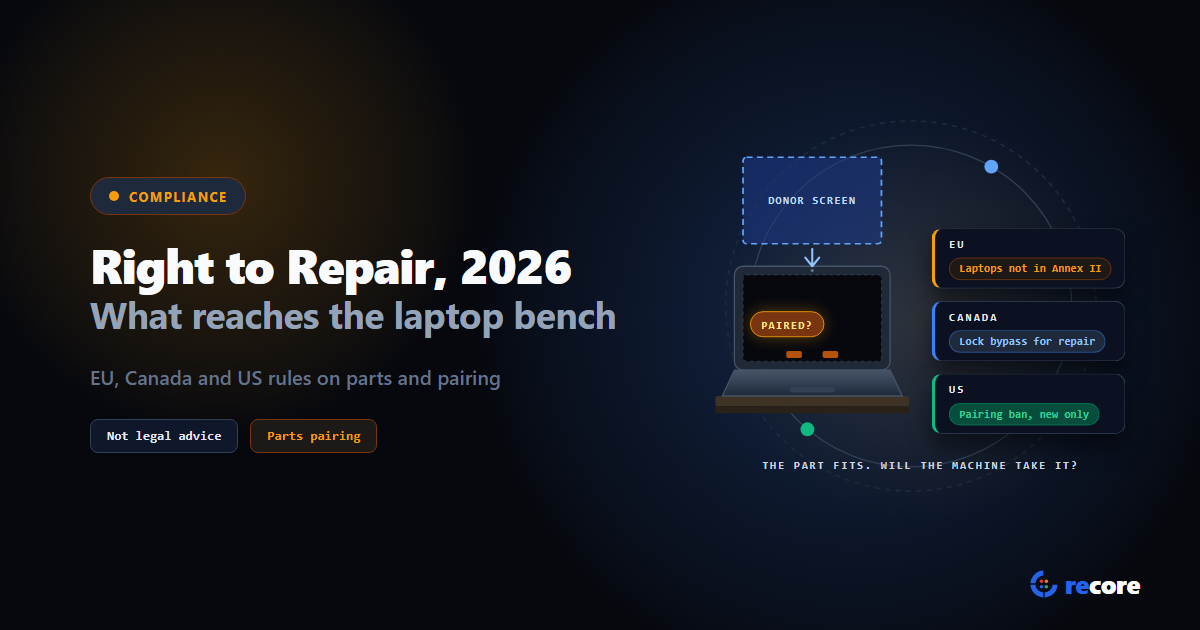
Right to Repair in 2026: What Changes on a Laptop Refurbisher's Bench
The EU directive is law in some countries, Canada and Quebec have new rules, three US states restrict pairing on new units. What it means for refurbishers.
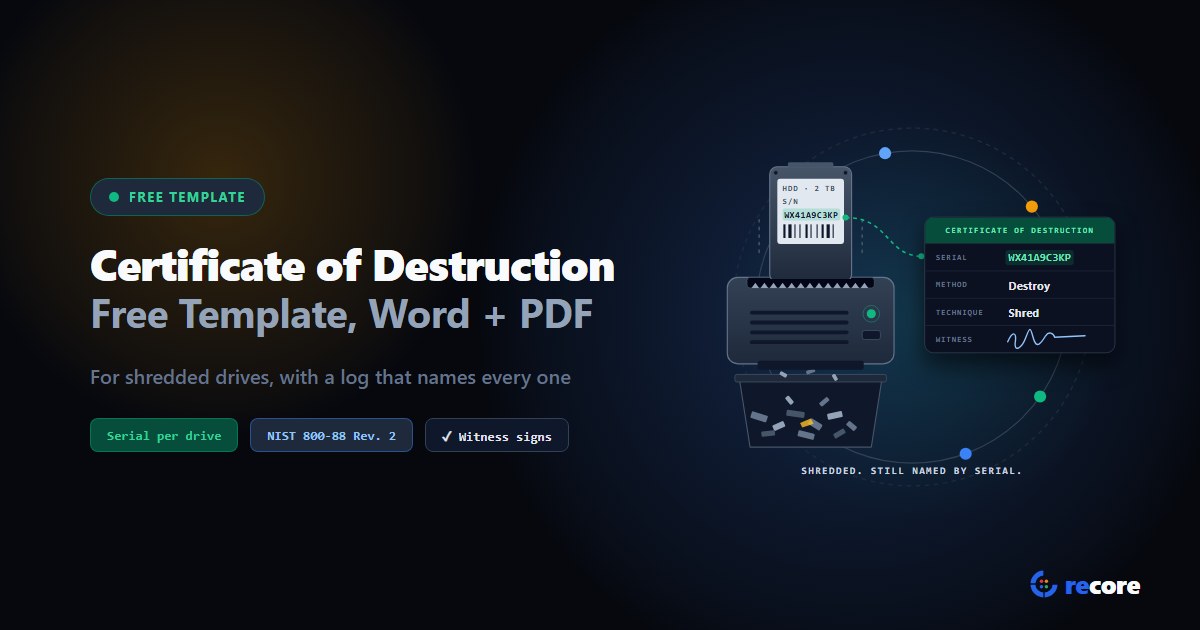
Certificate of Destruction Template for Hard Drives (Free, Word + PDF)
A free certificate of destruction template for hard drives and SSDs, in Word and PDF, with a per-drive log and the fields NIST SP 800-88 Rev. 2 lists.
Stay Ahead in Data Sanitization & ITAD Compliance
Join enterprise IT managers and electronics refurbishers receiving our monthly technical standards breakdowns, NIST/R2v3 audit tips, and benchmark releases.