Does Degaussing Destroy a Hard Drive? What NIST SP 800-88 Rev. 2 Says
Under NIST SP 800-88 Rev. 2, degaussing is a Purge for magnetic drives only. Why it does nothing to SSDs, when a degausser is too weak, and what to record.
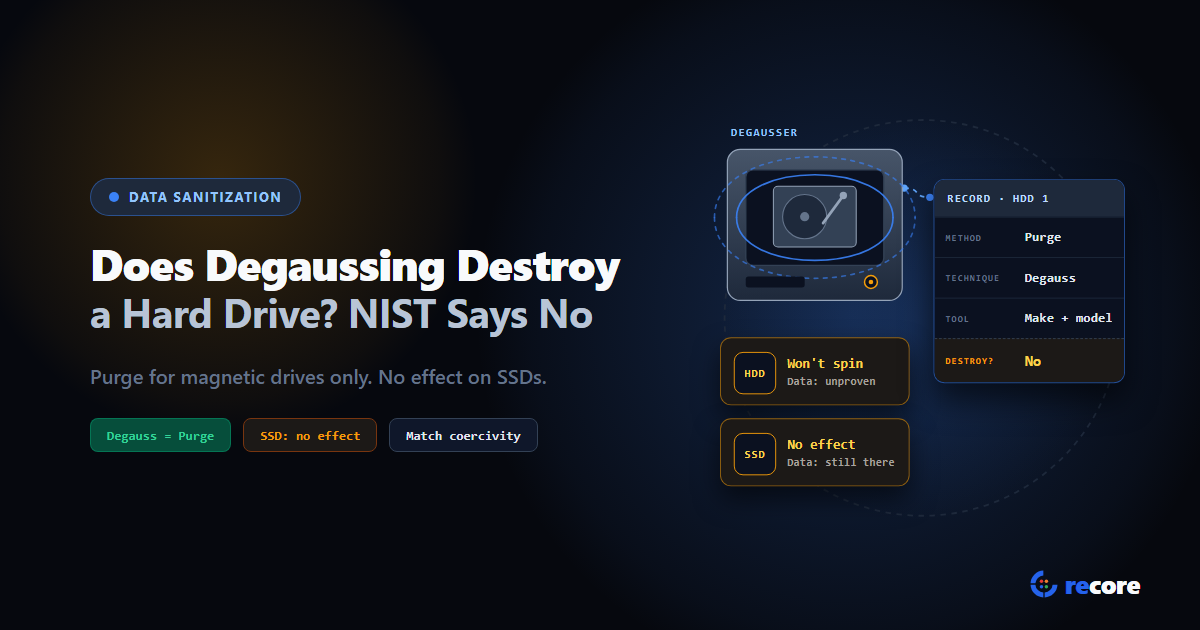
Does degaussing destroy a hard drive? Under NIST SP 800-88 Rev. 2, no. Degaussing is a Purge technique, and only for magnetic media. It can leave a hard drive dead and still fail to remove the data. It also does nothing to an SSD, an NVMe drive or a USB stick.
For shredding, see SSD reuse vs shredding. For the old multi-pass overwrite standard, see NIST 800-88 vs DoD 5220.22-M.
- Degaussing counts as Purge, for magnetic media only. NIST says it "is not considered an approved destroy sanitization technique."
- It has no effect on flash. Degaussing an SSD "can complete successfully, but no sensitive data is sanitized."
- The degausser has to be strong enough for the drive. NIST warns that many existing degaussers are too weak for newer, high-coercivity drives.
- A drive that won't spin up proves nothing about its data. Record the method as Purge, the technique as degauss, and the degausser you used.
What degaussing does
A hard drive stores bits as tiny magnetized regions on its platters. A degausser hits the drive with a strong magnetic field to wipe out that pattern. NIST's glossary (Appendix A) defines degauss as: "To reduce the magnetic flux to virtual zero by applying a reverse magnetizing field that is matched to the ISM coercivity." ISM, short for information storage media, is NIST's word for any storage device.
Coercivity is how strongly the material resists being demagnetized. The glossary calls it "a measure of the ability of a ferromagnetic material to withstand an external magnetic field without becoming demagnetized." That's why the definition says "matched".
The field also tends to damage the servo tracks, the markings the drive's heads use to find their place. NIST's July 2026 FAQ says degaussing high-coercivity modern drives "often disrupts internal servo tracks and renders the drive permanently inoperable." So a degaussed hard drive usually can't be resold.
Where Rev. 2 puts degaussing
Of NIST's three methods, Clear and Purge aim to leave the device reusable, and Destroy leaves it unusable. Section 3.1.2 says Purge makes "the recovery of target data infeasible using state-of-the-art laboratory techniques but preserves the ISM in a potentially reusable state."
Degaussing sits in that section, as a physical Purge technique: "Physical purge sanitization techniques historically included degaussing for magnetic tapes, magnetic removable disks, and magnetic hard disk drives."
The same section rules out Destroy: "At the time of this writing, degaussing is not considered an approved destroy sanitization technique (see Sec. 3.1.3), but IEEE 2883 and/or NSA/CSS Policy Manual 9-12 should be consulted for further clarification."
Appendix D, the change log, says the degaussing guidance "has been updated to limit its applicability and clarifies that it does not currently constitute a destroy sanitization technique, even when it renders an ISM inoperable."
Is degaussing NIST compliant?
A degausser matched to a magnetic drive's coercivity can give you a Purge. Under Rev. 2 as written, it never gives you a Destroy, and on flash it gives you nothing.
Why degaussing does nothing to an SSD
SSDs, NVMe drives, USB sticks and memory cards hold data as electric charge in flash memory, with nothing magnetic for the field to act on. Section 3.1.2: "Degaussing should not be used for non-magnetic ISM (e.g., flash storage, such as SSDs)."
Section 4.5.2, on deciding whether a sanitization worked, gives this exact case: "a sanitization operation that degausses an SSD can complete successfully, but no sensitive data is sanitized."
Hybrid drives, which pair platters with flash, aren't safe either. FAQ Q8 says degaussing "can fail to sanitize the target data if applied to flash/hybrid components."
When a degausser is too weak
Section 3.1.2 names a second problem: "variations of magnetic recording technologies with higher coercivity (i.e., magnetic force). As a result, many existing degaussers do not have sufficient force to effectively degauss such ISM." A footnote (6) gives the condition for success: "Degaussing potentially renders a magnetic ISM purged when the strength of the degausser is carefully matched to the ISM coercivity."
The same paragraph says a drive can end up dead with its data still there. Degaussing, it says, "can damage (i.e., make unusable) some types of ISM, potentially rendering them inoperable (e.g., if the servo tracks are damaged), but fail to sanitize the target data."
Purge is judged against "state-of-the-art laboratory techniques", and a dead drive can't tell you what those could still read.
To check the degausser is strong enough, start with the drive: Section 4.3.1 says "knowing the coercivity of an ISM can help a user decide whether available degaussers can effectively degauss the ISM," and Appendix B asks drive makers to report it. For the degausser, Rev. 2 cites the NSA's Evaluated Products Lists. Check that your model is listed for the drives you handle.
Degaussing vs shredding
For medium- or high-security data on a magnetic drive, NIST prefers a strong, listed degausser to a shredder. Section 3.1.3 says "Pulverize and shred techniques for ISM should be avoided for anything but the lowest security categories of data." FAQ Q10 explains that shred and pulverize "are ineffective for medium- and high-security categories due to data density," and says "high-powered degaussers in NSF's EPL must be used for magnetic media, and techniques like incineration (e.g., smelting, melting) should be used for all other media (e.g., SSDs)." The FAQ prints NSF; the list Rev. 2 cites is the NSA's.
That degauss is still recorded as Purge. If your policy demands Destroy, record the destruction step separately.
For an SSD, neither one is right. Use the drive's own sanitize command to reuse it, or incineration if it must be destroyed. SSD reuse vs shredding covers that choice in detail.
What to use instead, by drive type
| Drive | Degaussing | What NIST points to |
|---|---|---|
| Hard drive you want to reuse | Often ends its working life | The drive's own sanitize command, a logical Purge (Section 3.1.2), or an overwrite, which is Clear (Section 3.1.1) |
| Hard drive your policy says to destroy, or one that has failed | Purge at best, and only with a matched degausser | A Destroy technique from Section 3.1.3, chosen per your policy and the data's security level |
| SATA or NVMe SSD | No effect | The drive's own sanitize commands, such as block erase or cryptographic erase (Section 3.1.2) |
| USB stick or memory card | No effect | A sanitize command if it has one; otherwise Destroy (Section 3.1.3) |
| Hybrid drive | Can fail on the flash part | The drive's own sanitize command |
Section 3.1.2 says logical Purge techniques "can include overwrite, block erase, and cryptographic erase using dedicated, standardized device sanitize commands," and sends you to IEEE 2883 for which technique fits which drive.
Plain overwriting doesn't reach all of a flash device. Section 3.1.1 says spare cells and wear levelling "make it infeasible for a user to sanitize all previous data using this approach." So if a stick with no sanitize command needs Purge, Destroy is what's left. Section 3.1.3 says destruction "may be the only option when the ISM fails or is obsolete (e.g., the ISM interface is no longer supported) and other clear or purge sanitization techniques cannot be effectively applied to the ISM."
What the record should say
Section 4.6 asks for a certificate of sanitization for each device. Among its fields are:
- "Sanitization method (i.e., clear, purge, destroy)"
- "Sanitization technique (e.g., degauss, overwrite, block erase, CE)"
- "Tool used, including version"
- "Verification method"
For a degaussed hard drive, that means method Purge, technique degauss, and the degausser's make and model as the tool. Write down the drive's type too, so the record shows the drive was magnetic. Section 4.5.2 says a result can be called into question when "the tools and/or equipment used were not approved and/or were improperly calibrated", so keep the degausser's calibration record with the certificate.
Don't write Destroy because the drive is dead. Section 3.1.3: "the ISM is not considered destroyed unless target data access or recovery is infeasible using state-of-the-art laboratory techniques." A degauss on its own goes on a certificate of sanitization. If you degauss and then shred, record both steps on a certificate of destruction, which has a place for each.
Where reCore fits
reCore doesn't degauss. It erases drives in software so they can be used again. On a station booted from the reCore OS, it uses each drive's own erase commands where the drive has them. On a hard drive, ATA Secure Erase in enhanced mode counts as Purge. When reCore runs inside Windows instead, it can only overwrite or use ATA Secure Erase, so most of those wipes are recorded as Clear. Every drive gets its own signed certificate that says Clear or Purge for what actually ran, and anyone can check it at recore.replugit.com/verify.
Questions about which method fits your drives? Email [email protected].
Sources
- NIST, SP 800-88 Rev. 2, Guidelines for Media Sanitization, September 2025: Sections 3.1.1, 3.1.2 (with footnote 6), 3.1.3, 4.3.1, 4.5.2 and 4.6; Appendix A (glossary: coercivity, degauss), Appendix B and Appendix D (change log).
- NIST, Frequently Asked Questions for NIST SP 800-88r2, July 16, 2026: Q8 and Q10.
Frequently asked questions
Can a degaussed hard drive be reused?
Usually not. NIST's July 2026 FAQ says degaussing high-coercivity modern drives "often disrupts internal servo tracks and renders the drive permanently inoperable." If you want to resell the drive, use its own sanitize command, or an overwrite, which is Clear, instead.
Does degaussing work on an SSD?
No. SSDs, NVMe drives and USB sticks store data in flash memory, which has nothing magnetic to erase. NIST SP 800-88 Rev. 2 says degaussing "should not be used for non-magnetic ISM (e.g., flash storage, such as SSDs)" and gives degaussing an SSD as its example of a job that "can complete successfully, but no sensitive data is sanitized." For an SSD, use the drive's own sanitize commands, such as block erase or cryptographic erase.
Is degaussing NIST compliant?
For magnetic media, it can be a Purge under NIST SP 800-88 Rev. 2, when the degausser's strength is matched to the drive's coercivity. NIST warns that many existing degaussers are not strong enough for newer high-coercivity drives, and it does not count degaussing as Destroy. It should not be used on flash storage at all.
Degaussing vs shredding: which one does NIST prefer?
Neither is a general answer. NIST SP 800-88 Rev. 2 says pulverizing and shredding should be avoided for anything but the lowest security categories of data. NIST's July 2026 FAQ says that for medium- and high-security data, high-powered degaussers from the NSA's evaluated list must be used for magnetic media, and techniques like incineration should be used for other media such as SSDs. If you want to reuse the drive, neither applies: use the drive's own sanitize command.
reCore Research Lab
OfficialCompliance & Security Group
Technical research group specializing in NIST SP 800-88, IEEE 2883, SERI R2v3 standards, and forensic data recovery testing.
Wipe every drive. Prove every wipe.
reCore picks the purge method for each drive, verifies the result, and issues a per-drive certificate that a second person approves.
Related Guides & Research
Continue exploring compliance standards, firmware sanitization, and hardware diagnostics.
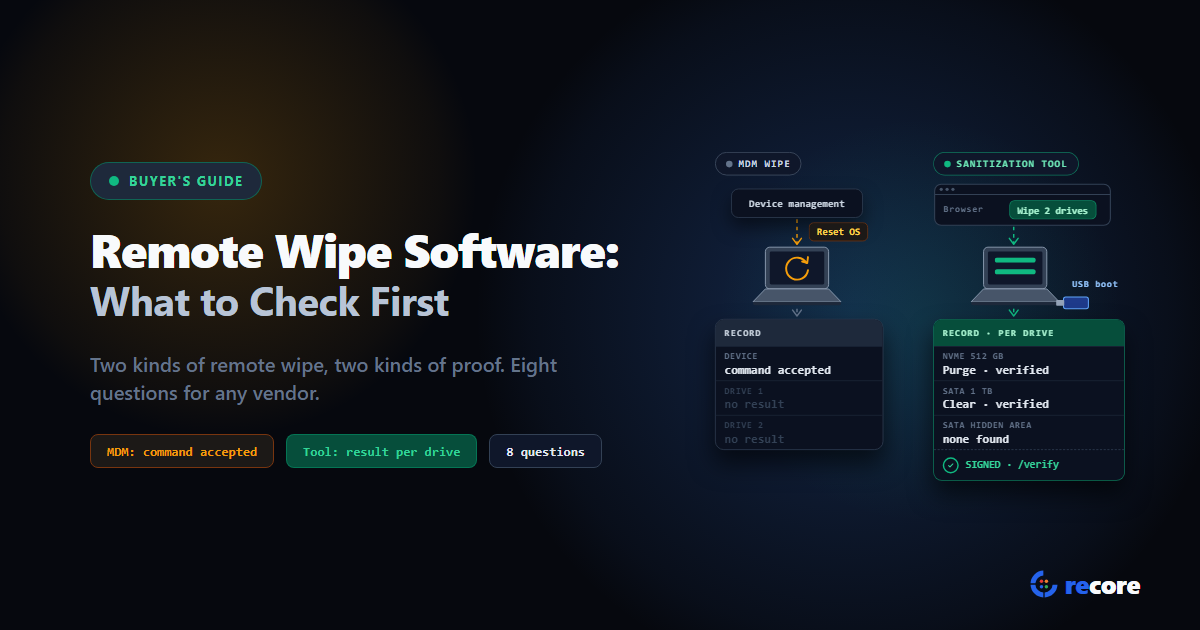
How to Choose Remote Wipe Software: 8 Questions to Ask
How to choose remote wipe software for an ITAD floor or IT team: the two kinds, what each proves, and eight questions to ask any vendor.
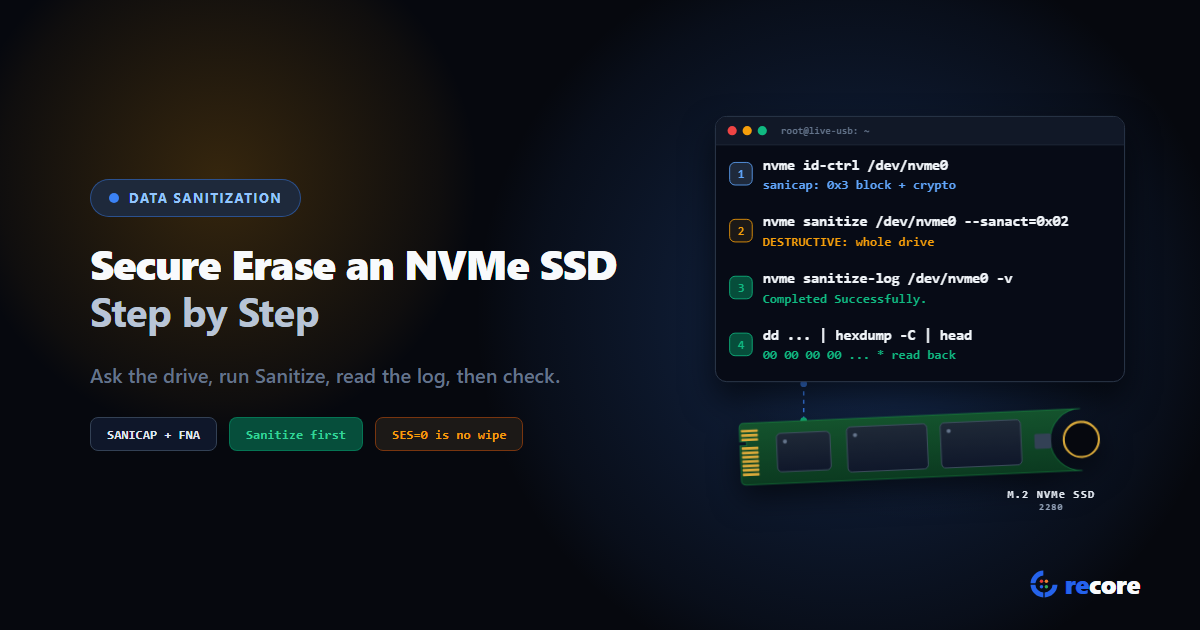
How to Secure Erase an NVMe SSD, Step by Step
The nvme-cli commands in order: check what the drive supports, run Sanitize or Format, watch it finish, check the result, and keep a record for each drive.
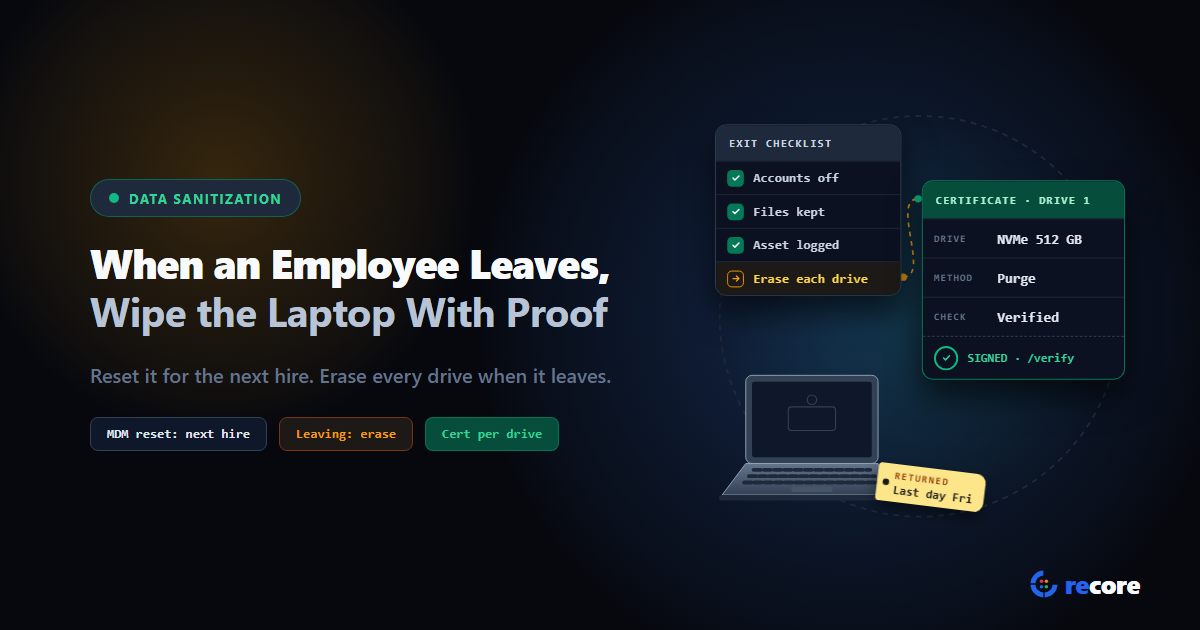
How to Wipe a Laptop When an Employee Leaves, With Proof
Reset it for the next hire, or erase every drive with a certificate if it leaves the company. What an MDM wipe proves, and an offboarding checklist.
Stay Ahead in Data Sanitization & ITAD Compliance
Join enterprise IT managers and electronics refurbishers receiving our monthly technical standards breakdowns, NIST/R2v3 audit tips, and benchmark releases.