5%, 10% or 100%? How Much of a Wiped Drive You Should Read Back
NIST, ADISA, IEEE 2883 and R2v3 each set a different verification number, and two of them don't measure the same thing. What each requires, and how to choose.
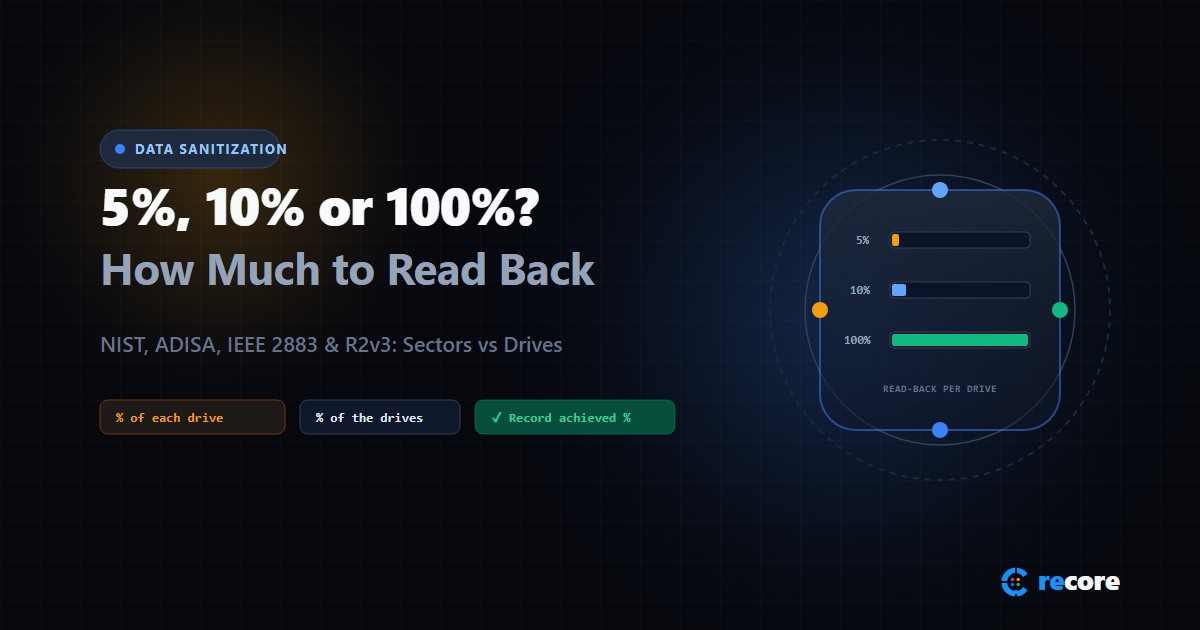
Ask three ITAD vendors how much of a wiped drive they verify and you can get three answers: 5%, 10% and 100%. Ask an auditor about "5% sampling" and they may mean something else entirely.
Both confusions have the same cause. The standards set different numbers for different things, and the word "verification" is used for all of them. This article separates them, quotes what each source actually says, and ends with a practical way to choose.
Quotes come from NIST SP 800-88 Rev. 2 (September 2025) and Rev. 1 (December 2014), ADISA's Data Capability Requirements v6.3, and SERI's R2v3 guidance. We did not read IEEE 2883 directly; where it is cited, it is through ADISA's description of it.
1. Two different questions
Every verification number answers one of two questions:
| Question | Unit | Who sets a number |
|---|---|---|
| How much of each drive is read back after the wipe? | Percent of the drive's addressable space | NIST Rev. 1 (about 10%), ADISA (5% or 100%), IEEE 2883 (5%, per ADISA) |
| How many wiped drives get a second, independent check? | Percent of drives | R2v3 (5% of logically sanitized media), NIST Rev. 1 (at least 20%) |
Mix them up and you get statements like "we meet the 5% rule" that may satisfy one requirement and say nothing about the other.
2. How much of each drive: what the sources say
NIST SP 800-88 Rev. 2 (current). No fixed percentage. Section 4.5.1: "Unless explicitly required by organizational policy, elaborate sampling of an ISM's contents (e.g., full or representative) after clear or purge sanitization techniques is not necessary." Verification for tool-based wipes means "checking the completion status of the tools and identifying errors, anomalies, and the health of the ISM." The read-back depth is your policy decision. (We covered the rest of Rev. 2's verification and validation split in our Rev. 2 evidence guide.)
NIST SP 800-88 Rev. 1 (superseded, but still referenced). Section 4.7.3 calls a full read of all accessible areas "the highest level of assurance of effective sanitization (outside of a laboratory)" and says it "should be performed if time and external factors permit." Its representative-sampling method is specific: split the drive into at least 1,000 subsections, read at least two non-overlapping pseudorandom locations in each, each covering at least 5% of its subsection, plus the first and last addressable locations. In NIST's words, the result "should cover at least 10 % of the media."
ADISA (Data Capability Requirements v6.3). For magnetic, solid-state and hybrid drives, DIAL 1 and DIAL 2 require "verification of 5% of user addressable space," and DIAL 3 requires "verification of 100% of user addressable space." Footnote 4: "IEEE 2883:2022 only requires 5% of user addressable area to be verified. For DIAL 3 100% verification is required." ADISA also notes this verification "is typically a configurable feature of the sanitisation software being used which takes place immediately after the sanitisation algorithm/commands complete." ADISA's recognised references are NIST 800-88 Rev. 1 and IEEE 2883:2022.
| Source | Read-back per drive |
|---|---|
| NIST Rev. 2 | No fixed figure; set by organizational policy |
| NIST Rev. 1 representative sampling | At least 10% |
| IEEE 2883:2022 (per ADISA) | 5% |
| ADISA DIAL 1 and 2 | 5% |
| ADISA DIAL 3 | 100% |
3. "Purge means 100%" is not in the sources
A common claim is that purge, or IEEE 2883, requires a full read-back of every purged drive. We did not find that in the primary sources above. NIST Rev. 2 sets no percentage for purge. ADISA ties 100% to DIAL 3, which also requires purge, but the requirement belongs to the assurance level, not to the method. And ADISA's own summary of IEEE 2883 is 5%.
Full verification is still the strongest per-drive check, and a contract may demand it. Just make sure that's the reason you're doing it, rather than a misread standard.
4. Why a fixed sector count can mean almost nothing
Some tools verify a fixed number of sectors regardless of drive size. The arithmetic shows why percentage-based coverage matters:
- 1,000 sectors × 512 bytes = 512,000 bytes.
- On a 1 TB drive (1,000,000,000,000 bytes), that is about 0.00005% of the drive.
That is roughly 100,000 times less than ADISA's 5%. A certificate that reports a sector count without a percentage can look thorough and cover almost nothing. Ask for coverage as a share of addressable space.
5. How many drives: independent sampling
The second question is about people and tools, not sectors.
- R2v3, Appendix B(13). As quoted in SERI's quality-control guidance: "A minimum of 5% of logically sanitized data storage media shall be routinely sampled by competent and independent party to demonstrate data is not recoverable by commercial software." SERI is clear that this is "more than simply verifying the sanitization records and reports generated by the sanitization software," and that after sustained clean results the sample can fall toward 1%.
- NIST Rev. 1, Section 4.7.3. A random subset of sanitized media should get secondary verification with "a different verification tool," from "a separate developer," performed as a full verification, on "at least 20 % of sanitized media (by number of media items sanitized)."
Neither replaces the per-drive read-back. They check that the per-drive process is working.
6. Cryptographic erase is different
After cryptographic erase, the drive's contents become unreadable ciphertext, so there is no expected pattern to compare against. NIST Rev. 1 describes the most effective approach as reading pseudorandom locations before the erase and again after, then comparing. It notes the area covered "may be relatively small (or at least lower than the above guidance of 10 %...)" but should still span the drive. NIST Rev. 2's FAQ adds strict preconditions for cryptographic erase itself, which we cover in our Rev. 2 guide.
7. What it costs in bench time
Read-back time scales with coverage. A simple model: time ≈ coverage × capacity ÷ sustained read speed.
As an illustration only, assume a drive that sustains 500 MB/s reads:
| Capacity | 5% | 10% | 100% |
|---|---|---|---|
| 1 TB | about 1.7 min | about 3.3 min | about 33 min |
| 4 TB | about 6.7 min | about 13 min | about 2.2 h |
Real speeds vary widely by drive, interface and health, so measure your own. The shape matters more than the numbers: moving from 10% to 100% multiplies verification time by ten, on every drive.
8. How to choose
- Start from the contract. If a customer specifies a DIAL, a percentage or full verification, that's your number. (Our SSD reuse article lists the other terms worth agreeing.)
- Set a floor in policy. NIST Rev. 2 leaves depth to you, so write it down. A percentage of addressable space, not a sector count.
- Use 100% where the risk justifies it. High-sensitivity data and DIAL 3 contracts. Plan bench capacity for it.
- Keep independent sampling separate. If you're R2v3 certified, the 5% device sample with recovery software is its own process, done by someone independent of the wipe.
- Record what was actually achieved. The certificate should show coverage achieved, not just coverage requested.
9. Where reCore fits
reCore's verification is a percentage of each drive's user-addressable space, not a sector count.
- A 10% floor by default. Reads are spread across the drive in windows, with two non-overlapping samples per window, following the structure of NIST Rev. 1's representative sampling. A request below the floor is raised to the floor, and the record shows that it was.
- Assurance level set once, per organization. In settings, an organization can choose ADISA DIAL 1, 2 or 3. DIAL 1 and 2 keep the 10% floor, which is above ADISA's 5%. DIAL 3 reads back 100% and requires a hardware purge, failing the wipe rather than falling back to an overwrite.
- The certificate states what was achieved. It reports coverage, sectors checked and mismatches, and labels the strongest bar the coverage actually clears.
- Cryptographic erase is verified differently. Marker data is written before the erase and checked afterwards to confirm it is gone.
reCore's per-drive read-back is not the independent R2v3 sample. That sampling, with recovery software and a person independent of the wipe, remains a separate process for the facility. See the data wipe page for the methods reCore supports.
Conclusion
"5%" can mean five percent of a drive or five percent of the drives. "Verified" can mean a tool exited cleanly or that every sector was read. The fix isn't to pick the biggest number. It's to write down which question each number answers, set your floor as a percentage, and make the certificate say what was actually achieved.
Sources
- NIST, SP 800-88 Rev. 2, September 2025, Section 4.5.1.
- NIST, SP 800-88 Rev. 1, December 2014, Section 4.7.3 (superseded by Rev. 2).
- ADISA, Data Capability Requirements v6.3, Standard 8.0, sanitisation requirements by media type and footnote 4.
- SERI, Verifying the Effectiveness of the Data Sanitization Process, updated June 14, 2022.
Frequently asked questions
How much of a drive does NIST SP 800-88 require you to read back after a wipe?
Rev. 2 (September 2025) requires no fixed percentage. Section 4.5.1 says elaborate sampling, full or representative, after clear or purge is not necessary unless organizational policy requires it, and describes verification as checking tool completion status, errors, anomalies and media health. The superseded Rev. 1 described a representative sampling method that works out to at least 10% of the media, and called full verification the highest assurance.
What verification do ADISA DIALs require?
ADISA's Data Capability Requirements (v6.3) specify verification of 5% of user addressable space for DIAL 1 and DIAL 2, and 100% for DIAL 3. Footnote 4 adds that IEEE 2883:2022 only requires 5% of user addressable area to be verified.
Does Purge require 100% verification?
Not in the primary sources we reviewed. NIST Rev. 2 sets no percentage for purge, and ADISA ties 100% verification to DIAL 3, not to the purge method itself. Treat claims that IEEE 2883 or NIST require a full read-back for every purge with caution unless they quote the standard.
Is R2v3's 5% the same as ADISA's 5%?
No. ADISA's 5% is the share of each drive's addressable space read back after sanitization. R2v3 Appendix B(13) requires at least 5% of logically sanitized media, counted in drives or devices, to be sampled by a competent, independent party using recovery software. One measures sectors within a drive, the other measures how many drives get a second, independent check.
How do you verify cryptographic erase?
You can't compare post-erase contents to a known pattern, because the data becomes unreadable ciphertext. NIST Rev. 1 describes reading pseudorandom locations before and after cryptographic erase and comparing them, and notes the area covered may be smaller than 10% but should still be spread across the drive.
reCore Research Lab
OfficialCompliance & Security Group
Technical research group specializing in NIST SP 800-88, IEEE 2883, SERI R2v3 standards, and forensic data recovery testing.
Automate Testing & Evidence for R2v3 Operations
Deploy reCore across hundreds of devices simultaneously with zero-touch PXE or USB boot. Generate SHA-256 verified PDF erasure certificates with separation of duties enforcement.
Related Guides & Research
Continue exploring compliance standards, firmware sanitization, and hardware diagnostics.
SSD Reuse vs Shredding: What Makes Reuse Defensible, and What Your Contract Should Say
NIST SP 800-88 Rev. 2 advises against shredding modern storage for anything but low-sensitivity data. What SSD reuse needs to be defensible, and the contract terms to agree.
One Year After NIST SP 800-88 Rev. 2: A Wipe Result Is Not a Sanitization Record
NIST SP 800-88 Rev. 2 moves the focus from wipe techniques to sanitization programs, verification, validation and records. What an ITAD record should prove.
DBAN for SSDs: Does It Actually Work? What to Use Instead in 2026
Can DBAN wipe an SSD? Learn why DBAN is designed for HDDs, how SSD and NVMe sanitization works, and what to use instead.
Stay Ahead in Data Sanitization & ITAD Compliance
Join enterprise IT managers and electronics refurbishers receiving our monthly technical standards breakdowns, NIST/R2v3 audit tips, and benchmark releases.